


You leave at 7:30 for a commute that eats an hour, and you are not walking back through the door until well after six. Your dog has been holding it, staring at the door, and slowly running out of things to do since breakfast. That gap is the real problem, and no amount of guilt fixes it. What does fix it is a plan, and for most Chicago pet parents the plan is simpler and less expensive than they expect.
The American Kennel Club puts the baseline at a minimum of two hours of dedicated social time with people or other dogs each day, broken into chunks. Elsewhere the AKC notes that most adult dogs handle roughly four to six hours alone without real distress. A standard Chicago workday plus a commute blows past both numbers. Here is how to close the gap.
The options, ranked by what most Chicago dogs actually need
- A midday walk: A visit from the same trusted walker breaks up the longest stretch of the day, gives your dog a bathroom break, and resets their stress level. This is the default answer for most apartment dogs.
- In-home pet sitting: A longer visit in your dog's own space. Best for anxious dogs, senior dogs, or pets recovering from illness or surgery.
- Doggy daycare: Hours of supervised group play. Genuinely great for social, high-energy dogs, and genuinely wrong for some others.
- Enrichment at home: Puzzle feeders, snuffle mats, and frozen treat toys that give your dog a job while you are gone. A supplement, not a solution.
- A consistent daily routine: Morning exercise, a calm departure, predictable meal times. Free, and more effective than most things you can buy.
Most pet parents end up combining two or three of these. The right mix depends on your dog's temperament, age, and how long the door stays closed.
Why a midday walk is the default answer for most Chicago dogs
If you only add one thing to your dog's day, make it a midday visit. Breaking up the longest unbroken stretch does more for a dog's stress level than extending the morning or evening walk, because the problem is not total exercise, it is the length of the gap. Purina's guidance on how long a dog can be left alone lands in the same place: somewhere around the four-hour mark, most dogs need a reset.
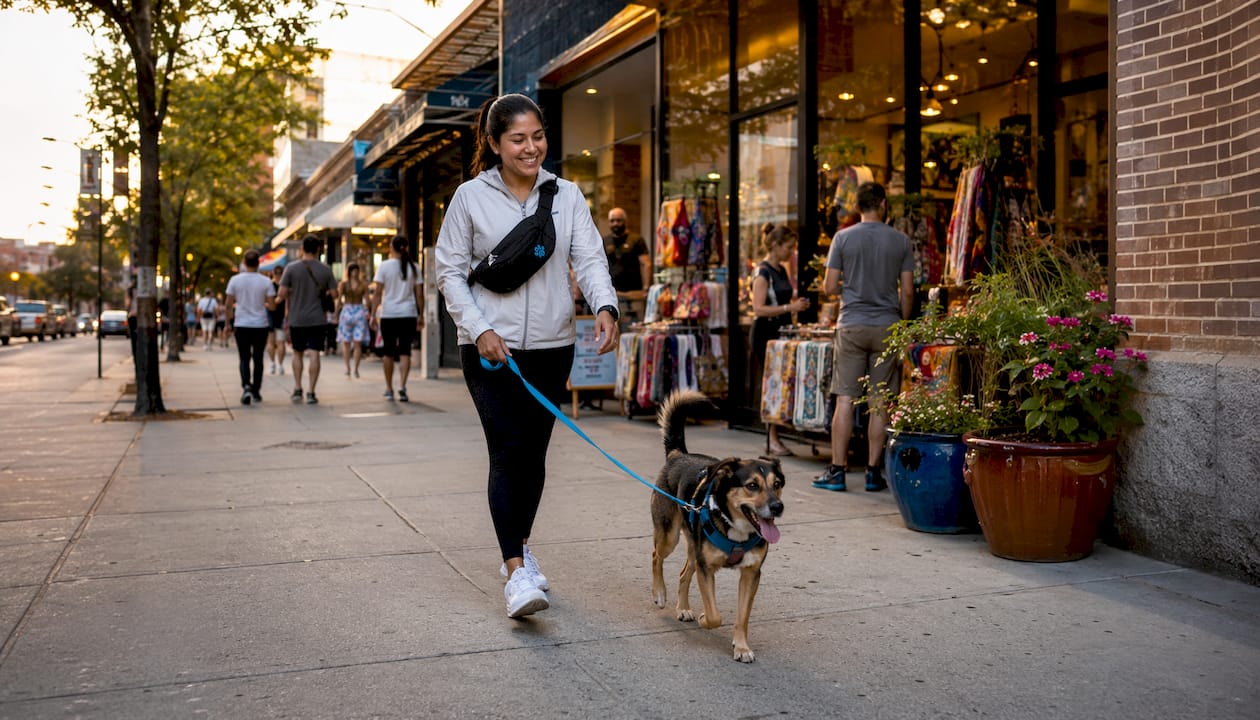
A midday walk does four things at once:
- Bathroom relief before your dog is genuinely uncomfortable, which prevents accidents in otherwise house-trained dogs
- Physical movement that takes the edge off the afternoon
- Mental stimulation from new smells on the block, which tires a dog faster than distance does
- Social contact with a person your dog knows and trusts
That last word is doing a lot of work. A rotating cast of strangers from an app gives your dog the walk without the relationship, and for an already unsettled dog, a new person in the apartment every few days is its own small stressor. The same walkers every visit is what turns a service into a routine your dog can actually relax into.
For dogs in Chicago apartments, the walk is also their entire outdoor world for the day. There is no yard to wander into. Ten minutes of sniffing a parkway on Damen or a stretch of Ravenswood sidewalk is not filler, it is the enrichment portion of their day.
When doggy daycare is the right call, and when it is not
Daycare does something a frozen Kong cannot: hours of live social interaction. For a social, high-energy dog, that is a genuinely excellent fit, and the behavioral upside is real. Dr. Vint Virga, board certified in veterinary behavior, described his own dog becoming noticeably more contented after starting one day a week of daycare, with better focus and more energy burned than toys alone could manage.
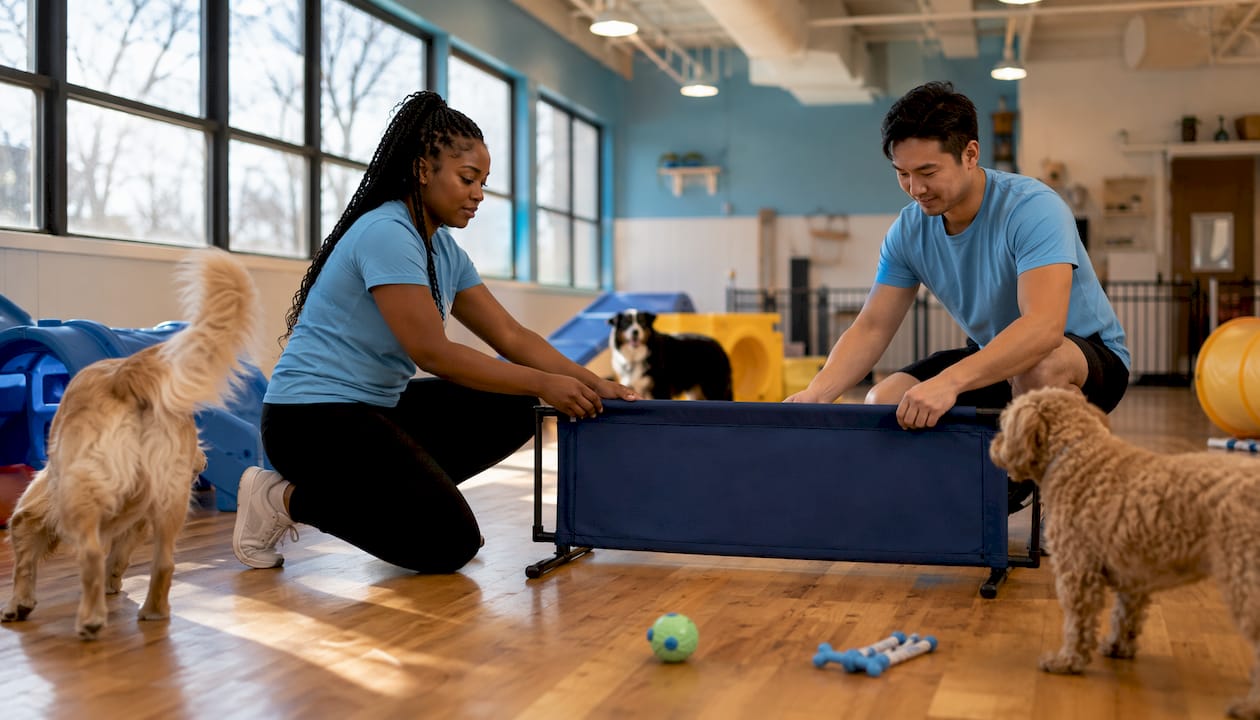
The honest caveat is the part most guides skip: not every dog likes daycare. High-anxiety dogs and those who find group settings overwhelming often come home more wound up, not less. Senior dogs and dogs with joint issues can find a full day of group play exhausting rather than satisfying. Daycare is also a facility, which means drop-off, pickup, and a commute that has to fit your real schedule, not your ideal one.
If you are considering it, a few things separate a good facility from a mediocre one:
- Dogs separated into groups by size and temperament, with genuine rest periods built into the day
- Staff trained in canine body language and pet first aid, and a straight answer when you ask their staff-to-dog ratio at peak hours
- A required temperament evaluation before your dog is admitted. If they skip this, skip them.
- Behavioral notes at pickup, not just a wave and a leash handoff
- A trial half day before you commit to a schedule
Watch your dog at pickup on that trial day. Tired and loose is a good sign. Trembling, frantic, or wired is worth taking seriously. For a broader look at vetting any care provider, the Sparky Steps guide to finding quality dog care in Chicago covers the criteria worth checking before you hire anyone.
For many Chicago dogs, the strongest setup is a hybrid: daycare two or three days a week for the social payoff, and a midday walk on the other days so the routine never fully breaks.
Other options worth knowing
In-home pet sitting
A sitter comes to your home, so your dog stays in their own environment with their own bed, their own smells, and no transport. That familiarity matters most for anxious dogs, senior dogs, and pets recovering from illness or surgery. Longer visits work well for dogs who need closer supervision than a standard walk allows.
A neighbor, friend, or family member
Legitimate for the occasional long day, and genuinely helpful when it works. The catch is accountability: a professional has a schedule, insurance, and a backup plan, and a favor does not. Use this as a supplement rather than your primary coverage, especially if your dog needs medication or has a medical condition.
Enrichment tools at home
Mental work produces a deeper calm than physical exercise alone during a long absence. A frozen Kong stuffed with peanut butter or wet food buys 20 to 45 minutes of focused problem solving. A snuffle mat hides kibble so your dog has to use their nose, and scent work is tiring in a way that pacing the living room is not. Puzzle feeders turn breakfast into a task instead of a ten-second event.
Pet cameras and treat dispensers
A camera with two-way audio solves two problems at once: your dog's boredom and your own worry spiral at 2 PM. Models with a treat dispenser let you reward calm behavior remotely, which helps during early alone-time training. A word of caution: some dogs get more agitated hearing a disembodied voice with no person attached, so watch how yours actually responds before relying on it. Setups combining cameras, enrichment, and check-ins tend to work better than any single tool.
Building a workday routine your dog can count on
Consistency is the most underrated tool you have, and it costs nothing. Dogs are creatures of habit, and a predictable structure reduces anxiety more reliably than any product.
Morning. Exercise before you leave. A brisk 30 to 45 minutes changes your dog's entire alone-time behavior. A tired dog sleeps. A bored, under-exercised dog redecorates. That means setting the alarm earlier, and it is worth it.
Departure. Keep goodbyes calm and short. A long, emotional farewell tells your dog that your leaving is a big deal worth worrying about. Hand over the enrichment toy, say the same neutral phrase every time, and go. The sameness is the point.
Midday. A visit or walk, which for anyone gone more than five or six hours is not really optional. This is the difference between a dog who copes and a dog who does not.
Evening. Feed at the same time daily. Consistent meal timing anchors the whole rhythm for anxiety-prone dogs. Follow with a walk or play session to close out the day.
Weekends. Do not blow up the schedule. Sleeping until noon on Saturday while your dog waits by the door for their 7 AM walk buys you a confused, unsettled dog on Monday.
For dogs who struggle with the transition to being alone, gradual desensitization is the reliable long-term fix: step out for 30 seconds, come back before your dog reacts, and slowly extend. This retrains your departure from a stress trigger into a normal event. The Sparky Steps guide to separation anxiety walks through the process step by step.
Dog-proofing your home before a long workday
No camera or puzzle toy matters much if your dog can reach something dangerous while you are out. Do a room-by-room walkthrough at your dog's eye level and look for what they can chew, reach, or knock over.
- Kitchen: Secure cabinets with cleaning products and anything toxic (grapes, onions, xylitol). A locking trash can lid pays for itself the first time.
- Living areas: Tuck or cover electrical cords. Remove or elevate toxic houseplants, including pothos, philodendron, and sago palm.
- Bathroom: Door closed or lid down, and medications behind a closed cabinet rather than on the counter.
- A designated safe space: A crate, pen, or gated room with their bed, water, and toys gives your dog a home base instead of the run of the apartment.
For a dog new to being alone or with a history of destructive behavior, start with a smaller dog-proofed space and expand access as trust builds. Age changes the math too, and the Dogster guide on leaving dogs alone covers the differences for puppies and seniors.
What the guidance actually says about alone time
| Care need | General guidance | Why it matters |
|---|---|---|
| Daily social time | At least 2 hours, split across the day | Prevents anxiety and boredom-driven destruction |
| Comfortable alone stretch | Roughly 4 to 6 hours for a healthy adult dog | Past this, stress and bladder strain climb |
| Midday break | Around the 4-hour mark | Resets stress and provides bathroom relief |
| Enrichment before you go | Puzzle or frozen treat toy | Occupies your dog through the first stretch |
| Seniors and puppies | More frequent breaks, often every 2 to 4 hours | Bladder control is shorter at both ends of life |
Breed matters too. Dogs with strong attachment to their people, including Labrador Retrievers, Border Collies, and German Shepherds, tend to be more prone to separation anxiety than more independent breeds. Some dogs also need a bathroom break well before the general guidance suggests, and a veterinary perspective on alone time is worth reading if yours has a medical condition. If you have a puppy or a newly adopted dog, the 7-7-7 socialization framework is a solid foundation for building a dog who adapts well to routines, though it is not a workday care plan on its own.
What I have learned about workday care in Chicago
By Michael Jaurigue, co-founder of Sparky Steps
"Most pet parents reach us after the patchwork phase: a neighbor one week, an app walker the next, a daycare they were never quite sure about. The dog is not reacting to any one of those choices, they are reacting to the fact that it changes constantly. Consistency is the whole product. Sort that out and most of the other problems get quieter on their own."
- Michael Jaurigue
Sparky Steps covers the middle of your day
If you are on Chicago's North Side and your workday runs long, this is exactly what Sparky Steps has been doing since 2016 for 250+ local families. Your dog gets the same trusted walkers every visit, not a different stranger each week, and every visit comes with GPS tracking, photos, and visit notes sent straight to your phone through DoTimely. The care team is licensed, bonded, and insured.
Services include dog walking, in-home pet sitting, home check-ins, and dog running for dogs who need more than a walk. Visits start at $17, with 30-minute walks at $27. We serve Albany Park, Andersonville, Avondale, Edgewater, Irving Park, Lakeview, North Center, North Park, Ravenswood, Roscoe Village, and Uptown, with cat sitting available citywide. ❤️
Key takeaways
| Point | Details |
|---|---|
| The gap is the problem, not the total | Breaking up the longest stretch does more than lengthening the morning or evening walk. |
| A midday visit is the default fix | For anyone gone more than five or six hours, a midday walk is the single highest-impact change. |
| Daycare fits some dogs, not all | Excellent for social, high-energy dogs. Anxious dogs and seniors often come home more stressed. |
| Enrichment supplements, it does not replace | Puzzle feeders and snuffle mats buy time and calm, but they are not a substitute for a break. |
| Consistency beats any product | The same walkers, the same times, the same routine is what lets a dog settle. |
FAQ
What should I do with my dog if I work all day?
Combine a morning exercise session before you leave, an enrichment toy like a puzzle feeder or frozen Kong, and a midday visit from a professional walker or in-home sitter. For very social dogs, part-time daycare two or three days a week is worth considering alongside the walks.
How long can a dog safely be left alone?
Most healthy adult dogs handle roughly four to six hours without significant distress, and should not routinely exceed six to eight. Puppies and senior dogs need more frequent breaks, often every two to four hours.
Is a midday dog walk worth the cost?
For anyone away more than four or five hours a day, yes. A midday walk provides bathroom relief, physical activity, and social contact that resets your dog's stress level for the afternoon, and a consistent walker who knows your dog adds reliability an app booking cannot.
Is doggy daycare better than a dog walker?
Neither is universally better, they suit different dogs. Daycare is excellent for social, high-energy dogs who thrive in groups. A one-on-one midday walk is usually the better fit for anxious dogs, senior dogs, and dogs who find group settings overwhelming. Many pet parents combine both.
What enrichment toys work best for dogs home alone?
Frozen Kongs stuffed with peanut butter or wet food, puzzle feeders used at breakfast, snuffle mats with hidden kibble, and long-lasting chews are the most effective for keeping a dog engaged and calm during a long absence.
Can a dog be left alone for three days?
No. Dogs need bathroom breaks, food, water, and social contact throughout each day. For any absence longer than a single workday, arrange in-home pet sitting, boarding, or a trusted caregiver.
How do I know if my dog has separation anxiety?
Common signs include destructive behavior only when alone, excessive barking or howling after you leave, accidents despite being house-trained, pacing, and frantic greetings when you return. A pet camera helps you see what actually happens, and a veterinarian or veterinary behaviorist can recommend a treatment plan.


