

A 4 to 6 foot fixed-length leash is the safer default for nearly every walk, and it’s not close. The narrow exception is a tape-style retractable, used only with a calm, recall-trained dog, in a wide-open, low-traffic space, on the end of an attentive adult’s hand. Everywhere else, the retractable’s extra freedom trades away the control you need most. The rest of this guide walks through the evidence, the injury data, and exactly how to make the switch without your dog missing a beat.
TL;DR:
- Retractable leashes increase injury risk due to mechanism failure, slack tension, and delayed stopping compared to fixed 4 to 6 foot leashes.
- Emergency room data shows approximately 357,000 leash-related injuries in the U.S. from 2001 to 2018, mainly neck traumas and human hand injuries.
- Retractable leashes support pulling behaviors by maintaining constant tension and should only be used in open, low-traffic environments with well-trained, calm dogs.
- For regular walks, a fixed leash enhances safety, control, and training, with a long line or front-clip harness recommended for supervised exploration and strong pullers.
- Transitioning away from retractables involves immediate stop, switching to a harness, and practicing with a standard leash and long line until the dog is reliably responsive.
Retractable Vs Standard Leash: Control, Safety, and Training Side by Side
The core tradeoff comes down to one thing: how fast can you stop your dog when it matters? A standard leash gives you that answer instantly. Grab six feet of nylon or biothane, and your dog is exactly as far from you as the leash allows, every single time. A retractable dog leash changes that math with every step, since the cord or tape length shifts constantly and the brake mechanism has a lag between “I squeezed the handle” and “the line actually stopped.”
That lag is the whole ballgame when a squirrel bolts across the sidewalk or a kid on a bike swerves too close.
Safety follows the same pattern. A standard leash has almost no moving parts to fail: a clip, a handle, a strip of material. A retractable leash is a small machine with a spring-loaded reel, a thin cord or tape, and a plastic housing, and mechanical failure of that reel is a well-documented hazard of the design. Training suitability tips even further toward the standard leash, since constant tension on a retractable line actually teaches a dog to pull, while a slack standard leash rewards walking calmly at your side.
| Factor | Standard leash | Retractable leash |
|---|---|---|
| Control | Instant, consistent response | Variable length, brake lag |
| Safety | Few failure points, lower hand-injury risk | Cord/tape hazards, mechanism failure risk |
| Training | Supports loose-leash walking | Rewards pulling with constant tension |
| Best environment | Sidewalks, traffic, training, reactive dogs | Open fields, empty beaches, calm dogs only |
The practical takeaway: default to the standard leash for city blocks, training sessions, vet visits, and anything with a reactive dog on the other end. Save the retractable, if you use one at all, for the handful of scenarios where wide open space and a well-mannered dog make the extra slack genuinely safe.
The Documented Risks: What ER Data and Vets Actually See
The injury numbers on leashes are bigger than most pet parents expect. A published analysis of U.S. emergency room data found roughly 357,000 leash-related ER visits between 2001 and 2018, split between about 193,000 injuries from dogs pulling and 136,000 from handlers getting tangled in the line. That’s not a rounding error. That’s a public safety pattern hiding in plain sight on your evening walk.

Veterinary clinics see a specific, repeating set of injuries tied to retractable use, and the mechanism behind most of them is simple physics. A dog on a long, thin cord builds up speed before it hits the end of the line, and that sudden stop transfers force straight into the neck and throat. Clinics report neck and tracheal trauma as a recurring result, alongside cord entanglement and rope-burn injuries when a leash wraps around a leg or an arm.
The human side of the ledger looks just as rough:
- Rope burns and deep lacerations from grabbing a taut cord to stop a lunging dog.
- Finger injuries, including partial amputations, when fingers get caught in a fast-retracting line.
- Falls and trip injuries from cords that are nearly invisible against pavement or grass.
- Mechanical failures like jammed locks or snapped cords that release a dog with zero warning.
None of this means every retractable leash is a ticking time bomb. It means the design has real, well-documented failure modes that a standard leash simply doesn’t have, and that gap should factor heavily into which one you clip on by default.
When a Retractable Leash Actually Makes Sense
Retractables aren’t villains. They’re a specialty tool, and like any specialty tool, they only work well in the hands of someone who knows exactly when to reach for them. The defensible use case is narrower than most packaging suggests:
- Your dog is calm on leash, doesn’t lunge at squirrels, bikes, or other dogs, and has a genuinely reliable recall.
- You’re an attentive adult handler who can operate the brake and lock without fumbling, never a kid or a distracted walker checking a phone.
- The environment is wide open with clear sight lines: an empty field, an off-hours beach, a quiet dog park with no crowd.
- There’s no meaningful pedestrian or vehicle traffic, and no children darting around who could trip the line.
If you check every one of those boxes, a retractable can offer a nice bit of sniff-and-explore freedom. If even one doesn’t apply, you’re better off elsewhere. When you do use one, choose tape over cord (it’s less likely to cut skin or snap under tension), cap the extended length around 16 feet, and never hand the handle to a child. A dog that’s still working on loose-leash manners or recall has no business on a retractable yet, full stop. The American Kennel Club is direct about this: retractables should come after a dog already walks reliably on a fixed leash, not before.
Why Retractables Undermine Training, and What Works Better
Here’s the training mechanic nobody puts on the packaging: a retractable leash keeps low, constant tension on your dog the entire walk, and dogs learn through tension whether we mean to teach it or not. Pull against the line, get more line. That’s an accidental reward loop for pulling, and it runs counter to everything loose-leash training is trying to build. A standard leash does the opposite. Slack leash, forward progress. Taut leash, we stop. The AKC’s guidance on retractable leashes confirms this is exactly why trainers so often ban them from group classes.
If your goal is calm walks and real recall, here’s the gear lineup that actually gets you there:
- A 4 to 6 foot fixed leash for daily walks, training reps, and anywhere with traffic or other dogs. This is your everyday tool, no exceptions.
- A 10 to 30 foot long line for supervised sniffing sessions and recall practice in open spaces. It gives your dog room to roam without the spring-loaded mechanics or the pulling feedback loop.
- A front-clip harness for dogs that pull hard, since it redirects forward momentum sideways instead of letting your dog’s full weight hit your shoulder.
Long lines take a little practice. Gather slack by stepping toward your dog rather than yanking, and use short “come and reward” recall drills so the line never turns into a tangle underfoot. Pair a long line with a front-clip harness for strong pullers, and you’ll get most of the freedom of a retractable with almost none of the risk.
How to Choose the Right Leash for Your Dog
Before you buy anything, run through a quick gut check. How reliable is your dog’s recall, honestly? What do your usual walks actually look like, sidewalks and crosswalks or open trails and empty fields? Is your dog still working on pulling, or has that ship largely sailed? Are there kids or heavy foot traffic anywhere near your route? Your answers to those four questions will point you toward one leash type almost every time.
Ask yourself a few more direct questions while you shop: Will I often be near traffic or crowds? Does my dog pull, lunge, or bolt at distractions? Do I actually need long-range sniffing freedom, or am I just drawn to the idea of it? Most pet parents land on “standard leash, daily driver” once they answer honestly.
If you do buy a retractable for those narrow, defensible moments, shop smart:
- Choose tape over thin cord. Tape is wider, grips better, and is far less likely to cause a laceration.
- Look for nylon or biothane materials on any fixed leash or long line, since both hold up to weather and repeated washing.
- Get a model with a proper traffic handle (a second grip point near the clip) for tight sidewalk moments.
- Check the clip and hardware for solid metal construction, not the flimsy plastic that snaps under real pressure.
- Skip bargain-bin retractable mechanisms. The lock and brake quality is exactly where cheap models cut corners.
How to Transition Safely Away From a Retractable
Ready to make the switch? Here’s a simple plan that won’t leave your dog confused about the new rules:
- Stop using cord-style retractables immediately, especially near traffic, and never wrap any leash line around your hand or wrist, standard or retractable.
- Swap to a harness for a few weeks during the transition. It adds a layer of neck protection while your dog adjusts to a new leash feel.
- Run short daily sessions on a 6-foot leash, rewarding any moment the leash stays slack. Dogs pick this up fast when the reward is consistent.
- Add a supervised long line once loose-leash habits stick, giving your dog structured sniff time without a spring mechanism in the mix.
- Only reintroduce a retractable, if at all, once your dog is rock solid on both the standard leash and the long line, and only in the open, low-traffic settings covered earlier.
Before any retractable session, run a quick equipment check: test the lock under load, inspect the cord or tape for fraying, and retire anything with a sticky or stiff brake. A few minutes spent re-thinking your retractable habits now saves a much worse afternoon at the vet later.
Why This Advice Comes From People Who Walk Dogs for a Living
Sparky Steps has been walking Chicago dogs since 2016, and Founder Michael Jaurigue holds Fear Free Certified Professional, CPPS, and NAPPS credentials, the kind of training that puts positive reinforcement and calm, controlled walks at the center of every recommendation here. The care team leans on the same principle this guide does: consistent handling and steady leash control beat extra length, every time.
An Alternative to Managing the Mechanics Yourself: Sparky Steps
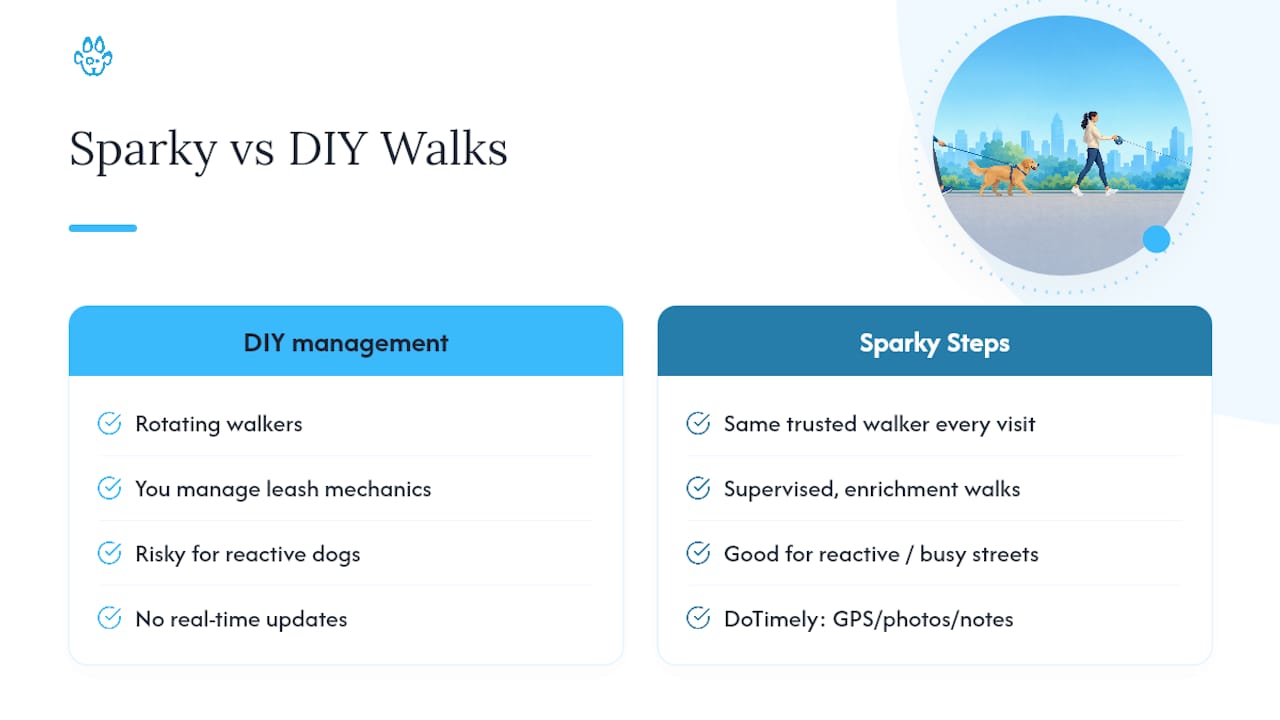
If all this leash talk is making you tired just thinking about brake mechanisms and cord inspections, there’s a simpler option. Sparky Steps gives Chicago pet parents the same trusted walkers every visit, so your dog gets supervised, enrichment-focused walks with real control, not a rotating cast of strangers fumbling with a retractable handle. That matters most for reactive dogs, busy North Side streets, or anyone who wants their dog to get a good sniff walk without personally managing a spring-loaded reel.
Every visit includes real-time updates through DoTimely: GPS tracking, photos, and notes, so you know exactly how the walk went even when you’re stuck at your desk. It’s a straightforward way to get the calm, controlled walks this guide recommends without becoming your own leash mechanic. For current pricing details, please visit their official website. Check availability and book a dog walk in your neighborhood to see what a consistent walker actually feels like.
Sources
For deeper detail beyond this guide, the PubMed analysis of leash-related ER visits, the AKC’s retractable leash guidance, and Preventive Vet’s breakdown of retractable pros and cons are worth a read for the medical and training specifics.
- Injuries associated with pet leashes: analysis of U.S. emergency visits (PubMed)
- Retractable Dog Leashes: When and How to Use Them Safely (AKC)
- The Hidden Risk of Retractable Leashes - Dunedin Animal Medical Center
FAQ
Why do vets recommend against retractable leashes?
Vets flag retractables mainly for the neck and tracheal trauma that happens when a dog hits the end of the line at speed, plus cord entanglement and mechanism failures. A standard leash removes most of that risk because there’s no sudden-stop physics involved.
Is it better to use a retractable leash or not?
For most walks, no. A fixed 4 to 6 foot leash gives you instant control and supports better training, while a retractable is best reserved for calm, well-trained dogs in wide-open, low-traffic spaces, as Preventive Vet’s guidance outlines.
Do dog trainers recommend retractable leads?
Most trainers recommend against them for regular use because the constant tension rewards pulling instead of loose-leash walking. The AKC advises that dogs should already walk reliably on a fixed leash before a retractable is even considered.
What are the risks of using a retractable leash?
The biggest risks are hand injuries from grabbing a taut cord, entanglement falls, and mechanism failures like jammed locks or snapped lines. ER data shows leash-related injuries add up to roughly 357,000 U.S. emergency visits between 2001 and 2018 alone.
How much does dog walking cost with Sparky Steps?
Dog walking visits with Sparky Steps start at $17 per visit, with a 30-minute visit priced at $27. Extra fees apply for things like weekend or same-day requests, and current details are always listed on the site.
Recommended
- Six Reasons to Re-Think Retractable Leashes
- How to Teach Your Dog Leash Etiquette
- Prong Collar vs Harness: Front Clip First for Chicago Dog Parents
The Sparky Steps Team used AI to research and outline this article. A human on the team edited and fact-checked the final text.


