


Most cat parents have heard it before: "Cats are so independent. They basically take care of themselves." It sounds reasonable, but it is not quite true. Understanding why cats need in-home care starts with recognizing that your cat is a territorial, routine-driven animal who experiences stress in ways most people never see. That stress has real consequences for their physical health and emotional wellbeing. This guide breaks down the science behind feline stress, the real risks of leaving cats without consistent care, and what you can do at home to keep your cat genuinely thriving.
Table of contents
- Key takeaways
- Why cats need in-home care: the stress connection
- How in-home care benefits your cat's health
- Practical strategies for effective in-home cat care
- The myth of the self-sufficient cat
- My honest take on in-home cat care
- How Sparky Steps supports your cat at home
- FAQ
Key takeaways
| Point | Details |
|---|---|
| Cats are stress-sensitive | Cats feel anxiety deeply, and unfamiliar environments or isolation can cause measurable health effects. |
| Vet visits create real fear | Over 50% of cat parents skip or delay vet care because of carrier stress, which harms long-term health. |
| Routine matters more than you think | Consistent feeding, litter care, and human interaction form the foundation of a healthy feline life. |
| Unsupervised time has a safe limit | Leaving cats alone beyond 24 to 48 hours poses serious risks to both their physical and emotional health. |
| Professional care fills the gap | In-home cat care services provide consistent, trustworthy support when you cannot be there yourself. |
Why cats need in-home care: the stress connection
Cats evolved as both predator and prey, which makes them deeply sensitive to anything unfamiliar or threatening. Their home territory is not just a preference. It is their psychological anchor. When that anchor is removed, even briefly, the effects show up fast.
Nowhere is this more visible than during veterinary visits. Only about 40% of cat parents visit the vet regularly, compared to 90% of dog parents. The biggest reason is not inconvenience. It is that the whole process, from seeing the carrier to arriving at the clinic, genuinely frightens cats.
Here is what the stress response actually looks like in practice:
- Hiding or freezing when the carrier comes out, sometimes days before an appointment
- Vocalizing, panting, or drooling during car rides, which are not normal feline behaviors
- Aggressive reactions during exams that make safe handling difficult
- Non-recognition aggression toward housemates after returning home, because vet visits disrupt scent recognition between bonded cats
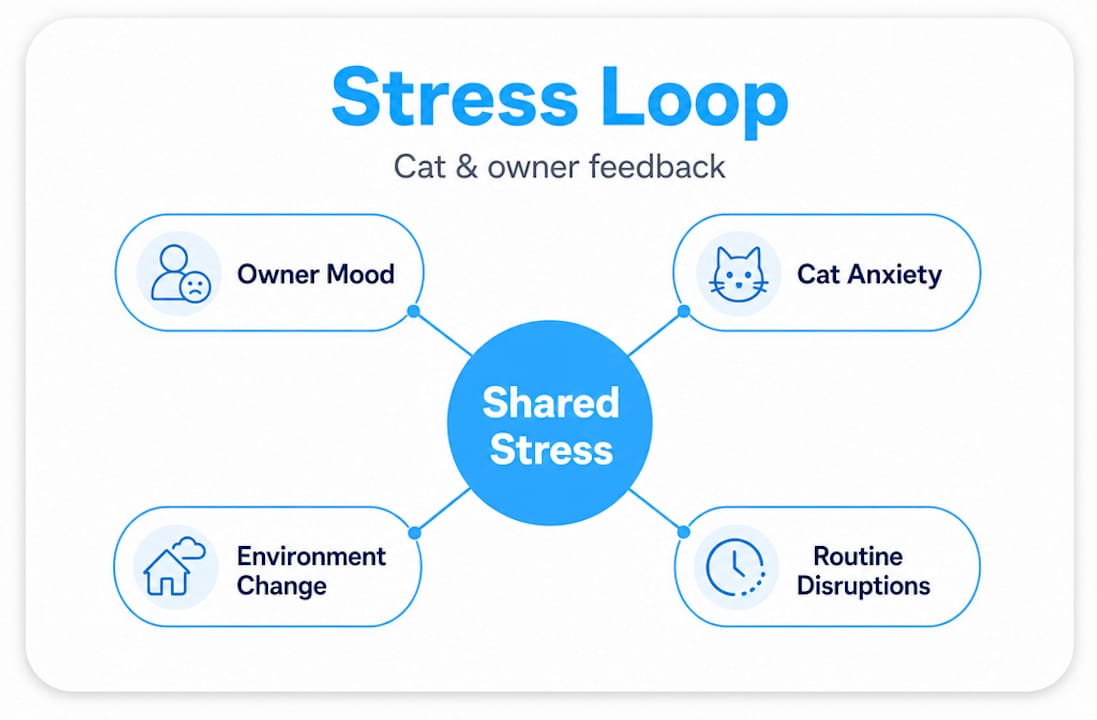
One factor most pet parents do not realize is the feedback loop between their own stress and their cat's. When you feel tense trying to get your cat into a carrier, your cat detects that emotional state and escalates their own anxiety. The result is each encounter becoming harder than the last. One fix that works well: leave the carrier out in your living space full time with a soft blanket inside, and let your cat explore it on their own terms. That single change significantly reduces carrier-related panic before vet visits.
The clinical consequences of this avoidance are serious. Cats miss vaccinations, dental checks, and screenings for conditions like kidney disease and hyperthyroidism that are far easier to treat when caught early. Stress-related care avoidance translates directly into worse health outcomes over a cat's lifetime.
"Cat-friendly approaches like allowing examination in the carrier reduce stress and improve care quality." (Source: NASC)
How in-home care benefits your cat's health
When your cat stays in their own environment with consistent daily care, everything works better. Their stress stays low, their routine stays intact, and you catch problems early. Those are not small wins. They are the foundation of a long, healthy life.
Here is how the benefits of in-home cat care stack up in practice:
- Stable feeding and litter routines. Cats thrive on predictability. A consistent feeding schedule and a clean litter box are not optional amenities. They are basic health requirements. Disruptions in these areas can trigger stress-related conditions like feline idiopathic cystitis, a painful urinary condition directly linked to anxiety.
- Early health detection. A consistent caregiver notices when your cat is drinking more water than usual, skipping meals, or grooming differently. These behavioral shifts are often the first signs of conditions like diabetes, hyperthyroidism, or dental pain. Catching them early changes outcomes dramatically.
- Reduced exposure to illness. Boarding facilities and even well-run catteries expose your cat to other animals, unfamiliar smells, and shared airspace. In-home care eliminates that exposure entirely, which matters especially for senior cats or those with compromised immune systems.
- Genuine social interaction. Cats are not antisocial. They are selectively social, which is different. A trusted caregiver who plays, talks to, and sits near your cat provides the low-pressure interaction cats actually seek. That interaction supports emotional health in ways that automated feeders simply cannot replicate.
- Environmental continuity. Your cat knows every corner of their home. Their scent is everywhere. Their favorite spots are accessible. Staying home means staying calm, and staying calm means staying healthy.
It also helps to ask your in-home cat sitter to send you photos of your cat's food consumption and litter box activity each visit. This creates a simple health log that can be surprisingly useful during vet appointments.
The importance of caring for cats at home goes beyond comfort. It is one of the most reliable ways to maintain their physical health between veterinary visits.
Practical strategies for effective in-home cat care
Knowing your cat needs consistent care at home is one thing. Setting that care up well is another. These strategies cover both the environment itself and the routines that keep cats feeling secure.
Creating a stress-reducing home environment
A cat's sense of security comes from predictability and access to safe spaces. Research on hospitalized cats has found moderate evidence that a hiding box helps cats cope faster in stressful situations, though the studies are small and the results are mixed. At home, this means giving your cat dedicated retreat spots, whether that is a covered bed in a quiet room, a shelf they own, or a cozy corner behind the couch.
Keep familiar scents consistent. Washing your cat's bedding too often, rearranging furniture, or introducing strong cleaning products can all disrupt their scent map of the home. These seem like minor details, but for a scent-dependent animal, they register as real changes.
Carrier familiarization at home
Carrier training is one of the best at-home care practices you can adopt. Make the carrier a permanent piece of furniture. Add positive reinforcement by placing treats, meals, or toys inside. Over weeks, most cats will begin voluntarily entering the carrier, which changes the entire vet visit dynamic.
Signs to monitor between professional visits
Here are the physical and behavioral changes worth tracking during daily in-home check-ins:
- Changes in appetite or water intake (up or down)
- Litter box changes in frequency, consistency, or avoidance
- Unusual hiding or withdrawal from normal routines
- Changes in coat quality or excessive grooming in one spot
- Vocalizing more or less than usual
- Limping, stiffness, or reluctance to jump
| Care method | Stress level for cat | Health monitoring | Cost consideration |
|---|---|---|---|
| In-home professional sitter | Low | High (daily observation) | Moderate |
| Boarding facility | High | Low (shared staff attention) | Moderate to high |
| Neighbor or family help | Variable | Variable | Low |
| Automated feeders only | High (isolation) | None | Low |
If your cat is truly carrier-resistant, talk to your vet about pre-visit sedation with gabapentin, which safely reduces anxiety and improves the experience for both the cat and the veterinary team. It is an increasingly recommended option for fearful cats, not a last resort.
The myth of the self-sufficient cat
The idea that cats are low-maintenance pets is one of the most persistent and damaging myths in pet parenting. It leads well-meaning pet parents to make decisions that genuinely harm their cats, usually without realizing it.
Here is what the research actually says. Leaving a cat alone beyond 24 to 48 hours poses significant risks to both their physical and psychological health. Cats are more sensitive to prolonged isolation than most people assume. The risks include:
- Water and food depletion, especially if an automated feeder malfunctions or a water bowl tips
- Litter box overflow, which causes cats to eliminate elsewhere and creates stress
- Medical emergencies going undetected, including urinary blockages, which can be fatal within 24 hours
- Behavioral deterioration from under-stimulation, leading to destructive behaviors or withdrawal
- Anxiety and depression, which show up as changes in appetite, grooming, and social behavior
The idea that a cat will "figure it out" if left alone for a few days is simply not supported by what we now know about feline welfare. Cats are adaptable, but they are not built for prolonged solitude. They need daily human interaction for both their emotional stability and their physical safety.
Recognizing your cat's at-home care needs is not about being overprotective. It is about being informed. For more on how to approach this thoughtfully, the Sparky Steps cat care blog covers veterinary-backed guidance on safe alone time and daily care standards.
My honest take on in-home cat care
By Michael Jaurigue, co-founder of Sparky Steps
I have worked with cats across every temperament, from social butterflies to the ones who spent their first month of visits hiding under the bed, and the pattern is always the same: the cats who get consistent, calm, in-home attention are genuinely different from the ones who do not. The ones I worry about most are the ones whose people think they are "fine" because they are not visibly distressed, since cats mask discomfort exceptionally well, and by the time it is obvious, a problem has often been building for weeks. What still gets me is how fast that changes once a caregiver becomes familiar: a cat who hid all of week one is often sitting on the sitter's lap by week three. That is not magic. That is just consistency doing what it does.
Michael Jaurigue
How Sparky Steps supports your cat at home
At Sparky Steps, we have been providing trusted, personalized in-home pet care across Chicago since 2016. Our cat sitting services are built around your cat's schedule, their comfort, and their individual personality. Every visit includes feeding, litter care, playtime, and real-time updates with photos sent directly to your phone so you always know how your cat is doing.
Whether you need daily check-ins during a work week or consistent coverage over a weekend, our experienced and insured caregivers keep your cat's routine exactly where it needs to be. Explore our full range of pet care services to find the right fit for your cat's needs.
FAQ
Why can't cats be left alone for more than 48 hours?
Leaving cats alone beyond 24 to 48 hours creates serious risks including food or water depletion, undetected medical emergencies, and significant psychological stress from isolation. Daily human check-ins are recommended by veterinarians to protect both their physical safety and emotional health.
What is the biggest benefit of in-home cat care over boarding?
In-home care keeps your cat in their own territory, which eliminates the stress of unfamiliar environments, strange animals, and disrupted routines. It also allows for personalized, one-on-one attention and early detection of any health changes.
How do I reduce my cat's carrier anxiety at home?
Leave the carrier out permanently as part of the home environment and use treats and meals to create positive associations with it. Consistent, low-pressure exposure over several weeks significantly reduces carrier-related stress and makes future vet visits far less traumatic.
How often should a professional sitter visit my cat?
Most cats benefit from at least one visit per day when their pet parent is away, with twice-daily visits preferred for kittens, seniors, or cats with medical needs. Consistent daily contact supports routine, safety, and emotional wellbeing. Learn more about how professional visits are structured in the Sparky Steps weekend sitting guide.
Can natural wellness practices support in-home cat care?
Yes. Alongside consistent routines and professional care, natural pet wellness practices like managing anxiety through environmental enrichment and mindful nutrition can complement your cat's daily care plan at home.

