


Keep your dog under threshold. That means creating distance from whatever sets them off, feeding high-value treats before the meltdown starts, and exiting calmly the moment things get too hot. That's the whole game on reactive dog walks, at least for today's walk. Long-term change comes later, through consistent training, but you need a safety net first.
Here's your pre-walk checklist:
- Check your dog's state: are they already stressed, hungry, or overtired before you even clip the leash on?
- Pick quiet routes and off-peak times: early mornings and side streets beat the dog park rush hour.
- Grab the right gear: front-clip harness or head halter, high-value treats (think chicken, not kibble), and a muzzle if that's part of your plan.
- Know your escape moves: a U-turn, a duck behind a parked car, a "let's go!" cue that means business.
- Have an exit word ready for when a walk needs to end early. No shame in that.
These are management tools, not a training plan. They buy you time and safety while you build real behavior change with desensitization and counter-conditioning, which we'll get into shortly.
Key takeaways
Reactive dog walks improve when pet parents combine distance management, positive-reinforcement rewards, and gradual DS/CC practice instead of relying on punishment or forced exposure.
| Point | Details |
|---|---|
| Manage before you train | Prevent trigger exposure first; that calm foundation is what makes later training possible. |
| Rule out medical causes | New or worsening reactivity deserves a vet visit before you assume it's purely behavioral. |
| Practice DS/CC in short reps | Start well beyond threshold distance and feed continuously while the trigger is visible. |
| Skip punishment and flooding | Yelling, dragging, and pain-based gear tend to escalate fear into bigger reactions. |
| Consistency matters | Sparky Steps pairs the same trusted walkers with planned routes and visit notes to protect your dog's progress. |
What leash reactivity is, and why walks set it off
Leash reactivity is over-the-top barking, lunging, or growling at a specific trigger, usually rooted in fear or frustration, not true aggression. A dog who is reactive is not necessarily dangerous; a truly aggressive dog intends harm, and the two are frequently confused. Walks are prime territory for this because the leash removes your dog's normal options: they cannot flee, and they cannot fully investigate, so they react instead.
Common triggers include:
- Other dogs, especially ones approaching head-on
- Cyclists, skateboards, or joggers
- Strangers in hats, sunglasses, or uniforms
- Children moving unpredictably
- Cars, trash trucks, or other loud moving objects
Every trigger has a threshold, the distance where your dog notices it but can still think, eat, and listen. Walk closer than that, and learning shuts off entirely. According to Cornell's Riney Canine Health Center, avoidance alone is not a permanent fix, it just prevents rehearsal of the behavior while you build the real, long-term answer through behavior modification and counter-conditioning.
How to keep everyone safe during a walk
Safety on reactive dog walks comes down to two things: prevention and a predictable way out. If you are not rehearsing the reactive behavior in the first place, you are already winning.
A few management moves that work in the real world:
- Scout your route ahead of time and skip narrow sidewalks or blind corners where you cannot see triggers coming.
- Use parked cars, hedges, or buildings as visual barriers when a trigger appears.
- Cross the street or make a wide arc before your dog clocks the trigger, not after.
- Fit a front-clip harness or a head halter like the Gentle Leader for extra steering control without choking your dog.
- Introduce a well-fitting basket muzzle if bite risk is a real concern. Basket-style muzzles let dogs pant, drink, and even take treats, so they are actually training-friendly.
Hold your leash at your core with a soft hand, or use a wrist loop, instead of gripping it tight at your side. A tense grip transmits your anxiety straight down the leash and can make your dog more reactive, not less.
Should you see a vet before starting training?
Yes, always, especially if the reactivity is new, has gotten worse, or seems tied to pain. A dog who suddenly snaps at approaching dogs might have ear pain, joint pain, or a neurological issue, not a behavior problem at all.
Ask your veterinarian for:
- A full physical exam
- Bloodwork if anything seems off
- A referral to a veterinary behaviorist if medical causes are ruled out
A veterinary behaviorist can build a full behavior-modification plan and, when appropriate, prescribe medication that lowers anxiety enough for training to actually stick. This is not a shortcut. It is what gets a genuinely overwhelmed dog into a headspace where learning is even possible.
Skills to teach before you work on proximity
Before you ever try to get closer to a trigger, teach your dog to check in with you on command. Attention and a solid emergency sit or stay are the foundation everything else builds on.
Practice these in your living room or backyard first, where there is zero pressure:
- Name game: say your dog's name, reward instantly when they look at you.
- Engage-disengage: reward your dog for glancing at something mildly interesting, then looking back at you.
- Emergency U-turn: practice a fast about-face paired with a happy "let's go!"
- Sit/stay under mild distraction: start with something boring, like a dropped sock, before graduating to anything real.
These focus behaviors echo foundation exercises popularized by veterinary behaviorist Dr. Sophia Yin, and they still hold up as some of the most reliable groundwork in the field. Aim for five-minute sessions, several times a day. Success looks like your dog taking treats calmly and glancing back at you on their own, without you asking twice. If your dog will not take treats during practice, you are too close to the distraction already. Back up before you try again.
How do you desensitize a dog to walk triggers?
Desensitization and counter-conditioning, or DS/CC, means showing your dog a trigger at a safe distance while feeding rewards, then stopping the moment the trigger disappears. Done right, your dog starts associating "scary dog appears" with "chicken appears," instead of "must scream and lunge."
Here is the basic protocol:
- Find your dog's threshold distance, the point where they notice a trigger but can still take treats.
- Start well beyond that. If your dog reacts at 30 feet, begin practice from 60 to 100 feet away, roughly the length of a city block or more.
- Feed continuously the moment the trigger is visible. Not a single treat, a steady stream.
- Stop feeding the second the trigger is gone. The timing is what builds the association.
- Repeat in short daily reps, not one marathon session.
- Decrease distance gradually, only after your dog is consistently calm at the current distance.
| Stage | Starting distance | Success looks like | Move closer when |
|---|---|---|---|
| Early | 60 to 100 feet | Dog notices trigger, still eats treats | Calm for 3 to 5 sessions in a row |
| Mid | 30 to 50 feet | Dog glances at trigger, then back at you | No barking or lunging for a full week |
| Advanced | 15 to 20 feet | Dog stays loose and relaxed, takes treats normally | Consistent calm across varied triggers |
If your dog stops eating or starts stiffening up, that is your cue to add distance immediately, not push through.
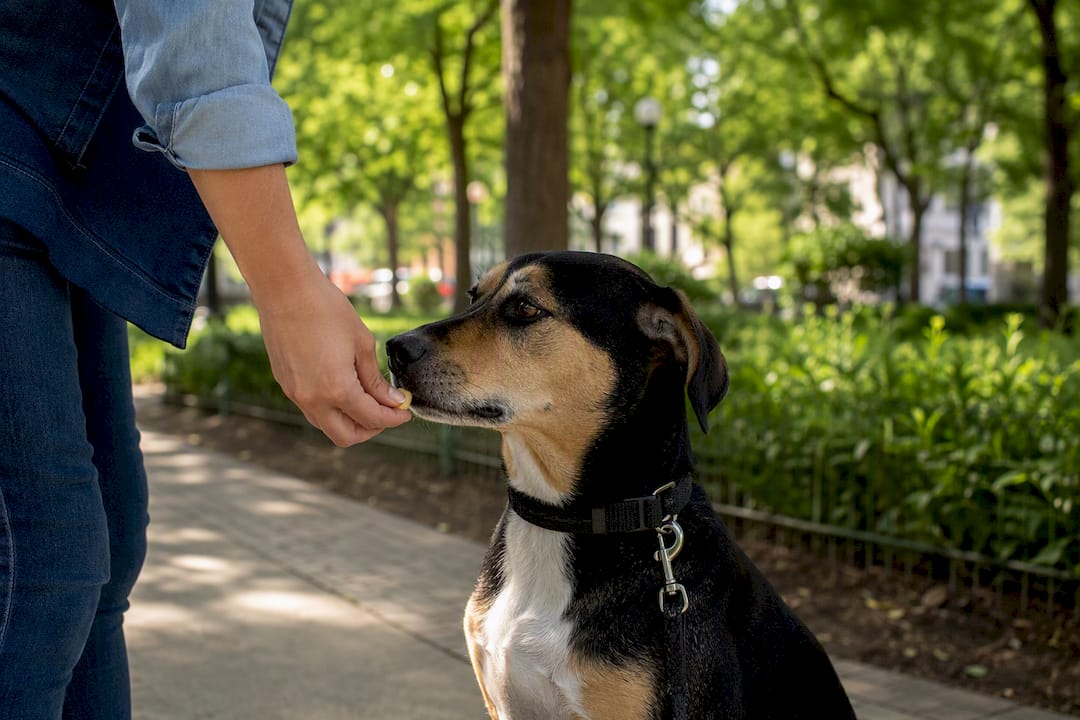
One small technique that makes a real difference: use pea-sized, high-value treats like boiled chicken or cheese, and feed them low and close to your leg so your dog is not stretching toward the trigger. That detail keeps you from accidentally luring them closer to the very thing you are trying to defuse.
What should you do when a trigger appears mid-walk?
Act early. Do not wait for the explosion to start managing it. The whole trick to reactive dog walks is spotting trouble before your dog does.
Here is the flow:
- See the trigger first, and if you can, redirect before your dog even notices.
- If your dog does notice but is still under threshold, mark it and feed.
- If they are clearly over threshold, create distance immediately: U-turn, duck behind a visual block, or cross the street.
- Use your practiced exit cue and walk away with purpose, not panic.
- If another dog or handler approaches, a calm "sorry, we're in training, can you give us space?" works better than you would think.
What not to do: no yelling, no jerking the leash, no forcing a "hello" because you feel awkward saying no. Awkward beats a bite every time.
What gear actually helps on reactive dog walks?
The right equipment lowers risk and supports training. The wrong equipment can quietly make things worse, even when your intentions are good.
- Front-clip harness: reduces pulling power and gives you better steering than a back-clip.
- Head halter (Gentle Leader style): offers precise directional control, useful for redirecting attention fast. Introduce it slowly with treats so your dog does not fight the fit.
- Basket muzzle: a properly fitted one allows panting, drinking, and treats, and it is a smart safety layer during training, not a punishment device.
- Long training line: useful for practice sessions in open, controlled spaces.
- Calming aids like a Thundershirt: some dogs settle with gentle, constant pressure, though results vary by dog.
Skip anything that relies on pain or discomfort, like prong or shock collars. They can suppress a warning growl without addressing the underlying fear, which sets the stage for a bigger blowup later.
When should you call in a professional?
Call a certified trainer or veterinary behaviorist if your dog has ever bitten someone, if the reactivity is escalating despite consistent work, or if you are genuinely afraid on walks. None of that is a personal failure. Some dogs need more support than a leash and a treat pouch can provide.
Red flags that mean it is time:
- Any bite history, even a minor one
- Reactivity getting worse week over week instead of better
- You cannot lower the threshold distance no matter what you try
- Ongoing safety concerns for you, your dog, or others
Bring video clips of actual episodes, a simple behavior diary, and vet records to your first consult. Ask directly about positive-reinforcement credentials before you book.
Common mistakes that make reactivity worse
Avoid punishment, flooding, and bracing against a tight leash. All three tend to backfire.
- Yelling at your dog: adds more chaos to an already stressful moment. Try a calm cue instead.
- Dragging them past a trigger: this is flooding, and it usually raises stress rather than resolving it. Add distance instead.
- Forcing greetings to be polite: skip it, and let your dog observe from a distance.
- Pain-based gear: suppresses symptoms without solving the fear underneath. Choose a front-clip harness or head halter.
- Inconsistent reward timing: confuses the association you are trying to build. Feed the instant the trigger appears.
What sets a professional walking team apart
Professionals combine tight management, consistent handling, and real reporting to protect the progress you have already made. That consistency is often the missing piece for reactive dogs.
- The same familiar walker every time, not a rotating cast of strangers your dog has to size up.
- Routes planned in advance around known trigger zones.
- Notes and photos after every visit, so you actually see the small wins.
- A clear path to escalate to a trainer or vet if something changes.
Ask your walking team to log threshold distances over time. A dog who tolerated triggers at 50 feet last month and 30 feet this month is making real progress, even if it does not feel dramatic day to day.
Small, boring, consistent wins
"Reactive dog walks are not about perfection. They are about showing up, reading your dog, and giving them a little more room than yesterday. Small, boring, consistent wins are the whole job. You got this!"
- Michael Jaurigue
How Sparky Steps supports reactive dogs on Chicago walks
If your dog needs the same calm, familiar face every walk instead of a new stranger each time, that is exactly the kind of consistency reactive dogs thrive on, and it is what Sparky Steps builds every route around.
- The same trusted walkers every visit, so your dog is not sizing up someone new each time
- Routes planned around your dog's known triggers and quiet hours
- Real-time GPS, photos, and visit notes after every walk through DoTimely
- Referrals to trusted, positive-reinforcement trainers and veterinary behaviorists when a walk needs more support than we can give alone
We are licensed, bonded, and insured, and we have spent 10 years learning the North Side's quiet streets and busy corners alike. If you are in Albany Park, Ravenswood, Andersonville, Uptown, or one of our other North Side neighborhoods, take a look at our Chicago dog walking and pet sitting services, and let's talk about a walk plan built around your dog's actual comfort zone.
Sources
- Understanding the difference between reactivity and aggression, AKC
- Managing reactive behavior, Cornell Riney Canine Health Center
- How can I safely walk my reactive dog? AAHA
- Managing a leash-reactive dog, Animal Humane Society
- Managing leash reactivity, Clicker Training
FAQ
How do I stop my dog from being reactive on walks?
Combine consistent management, like distance and the right gear, with daily short DS/CC sessions that pair a trigger's presence with high-value rewards. Progress is gradual, not instant.
At what age are dogs most reactive?
Reactivity often surfaces or intensifies during adolescence, roughly between six months and two years, though it can develop at any age, especially after a scary experience or an undiagnosed medical issue.
What should you not do with a reactive dog?
Never punish, yell at, or physically drag a reactive dog past a trigger. Punishment-based methods increase stress and can push a fearful reaction into defensive aggression.
Can reactivity be trained out of a dog?
Many dogs improve significantly with consistent DS/CC, professional guidance, and management, though "cured" is not always realistic. The honest goal is a dog who copes calmly, not one who never notices a trigger again.


