


Start with a harness, specifically a front-clip, non-tightening model, for the vast majority of dogs who pull on leash. Prong collars aren't the default tool for anyone: they belong only in narrow, trainer-supervised situations with strong dogs and experienced handlers, and even then, only temporarily. If your dog is brachycephalic, has a neck or spine issue, or gets anxious or reactive on walks, skip the prong collar entirely and talk to your vet about a harness or head collar instead. Never leave a prong collar on an unsupervised dog.
TL;DR:
- Prong collars are only suitable for strong dogs under trainer supervision and should never be used unsupervised due to safety risks.
- Research shows that front-clip harnesses and head collars are just as effective as prong collars in reducing pulling without the associated health risks.
- Proper fitting and consistent training are more important than the choice of device, with harnesses preferred for brachycephalic and injured-neck dogs.
- Back-clip harnesses may worsen pulling in food-motivated dogs, and aversive tools can increase stress and fear if used improperly.
- Hiring a trained walking professional can effectively address pulling issues and reduce reliance on equipment alone.
Prong collar vs harness: the at-a-glance comparison
Every walking tool trades off pulling control against comfort and welfare risk, and the right pick depends on your dog's size, temperament, and any health quirks. Here's how the two most common front-runners, plus a head collar option, stack up on the things that actually matter to a Chicago pet parent standing at the door with a leash in hand.
| Dimension | Easy Walk Harness (front-clip) | Gentle Leader (head collar) | Prong collar |
|---|---|---|---|
| Best for | Dogs who pull but don't need neck pressure | Dogs that respond well to head redirection | Strong dogs under a trainer's direct supervision only |
| Effectiveness at reducing pulling | Strong, especially with training | Strong once the dog acclimates | Strong, but pulling reduction doesn't equal welfare safety |
| Safety/welfare concerns | Low; watch for shoulder rub on ill-fitted straps | Low, but some dogs paw at the nose loop or seem stressed at first | Higher; concentrated pressure points and injury risk |
| Ease of use for pet parents | Easy, minimal learning curve | Moderate; needs a proper introduction period | Moderate to hard; requires correct placement and timing |
| Fitting and wear guidelines | Snug behind front legs, no chafing at the "armpits" | High on the muzzle, just behind the nose | Fitted high on the neck, snug but not tight, sized correctly |
| Vet/trainer recommendations | Frequently recommended as a first choice | Recommended for pet parents willing to train through the adjustment | Not recommended for routine use; PPG and AVSAB caution against it |
A few quick calls for common situations: puppies and small dogs almost always do better in a properly sized front-clip harness. Brachycephalic breeds (think French Bulldogs, Pugs, Boston Terriers) need a harness, full stop, because neck pressure can worsen their breathing. Strong adult pullers benefit most from the Easy Walk Harness or a properly introduced Gentle Leader. Anxious or reactive dogs generally do worse with any aversive tool, since discomfort tied to a scary moment can make the fear worse, not better.
Red flags to watch for, regardless of what's on your dog: labored breathing, coughing, skin rubbing, or a dog who suddenly freezes or tries to bolt when the leash goes on.
Prong collars: what they are, how they work, and the risks
A prong collar works by tightening a ring of blunt metal links around the neck when the dog pulls, distributing pinching pressure rather than the more even pressure of a flat collar. That pinch typically gets a fast response: dogs slow down because the sensation is uncomfortable, not because they've learned an alternative behavior.
The catch is that fast and safe are not the same thing. A 2024 study comparing leash equipment found both prong collars and front-connection harnesses meaningfully reduced pulling impulse compared to a martingale collar, with no measurable difference in pulling force between the prong and the harness. In plain terms: the harness worked just as well, without concentrating force on the neck.
That distinction matters because the neck houses the trachea, esophagus, thyroid, and major blood vessels feeding the eyes and brain. Veterinary and behavior organizations have flagged real medical concerns with aversive neck pressure, including spikes in intraocular pressure and a documented risk of escalating fear or aggression when punishment-based tools are used. The Pet Professional Guild goes further, actively advising against prong and choke collars and steering pet parents toward force-free alternatives instead.

If a trainer does recommend a prong collar for a specific, hard case, it should come with rules: correct sizing and placement high on the neck, supervised use only, a clear plan to phase it out, and never as a substitute for training. If a walking tool is doing all the work and your dog's behavior never actually changes when it's off, that tool is managing the symptom, not solving the problem.
Harnesses and head collars: which type fits your dog?
Not all harnesses are created equal, and the clip location matters more than most pet parents realize. Front-clip, non-tightening harnesses like the Easy Walk Harness tend to offer the best overall balance: they turn a dog's body slightly when it pulls, which naturally discourages forward momentum without pressure on the throat. A 2025 review of 21 studies on collars, harnesses, and head collars backs this up, concluding there is no single best device for every dog, but that non-tightening front-clip harnesses offer the best balance of comfort and pulling control for dogs that pull.
Back-clip harnesses are perfectly fine for dogs who already walk politely. But they can backfire for pullers. A Frontiers in Veterinary Science study found dogs pulled with meaningfully more force in back-connection harnesses than in neck collars when motivated by food, without a corresponding drop in visible stress signals. If your dog is food or squirrel motivated (most dogs are, let's be honest), a back-clip harness might make the pulling worse, not better.
Head collars like the Gentle Leader work through redirection: guide the head, and the body tends to follow. They can be remarkably effective, but they need patience. Some dogs paw at the nose loop or try to rub it off for the first several walks.
A few practical fitting notes:
- Harness padding and Y-shaped or chest-strap designs generally distribute pressure better and do not restrict shoulder movement.
- Puppies do best in lightweight, adjustable harnesses they can grow into gradually.
- Brachycephalic and neck-injury dogs should stick with a well-fitted harness; skip anything that touches the throat.
- Introduce a Gentle Leader indoors with treats before your first real walk.
- Measure your dog's girth and neck before buying; sizing charts vary by brand.
- Check for two-finger slack under any strap, never tighter, never looser.
- Watch the first few walks closely for chafing, limping, or avoidance behavior.
What the research actually shows
The 2024 PeerJ study on leash equipment is one of the more useful data points available, and it's worth understanding its actual scope. Researchers measured pulling force across 23 dogs on five-minute walks and found statistically significant reductions in pulling with both harnesses and prong collars compared to a martingale collar baseline.
That is a meaningful finding, but it is also a narrow one. Twenty-three dogs on short walks does not tell you much about long-term welfare, injury rates, or behavioral fallout over months of regular use. The 2025 review from University of British Columbia researchers Camila Cavalli and Alexandra Protopopova makes a similar point: after examining 21 full studies and two abstracts, the reviewers found no universal winner and recommended front-clip harnesses as a starting point for pullers precisely because the welfare trade-offs are better understood and more favorable.
The Frontiers study on leash tension adds an important wrinkle: harness type is not a guaranteed fix either. Back-connection harnesses produced higher tension readings than flat collars in food-motivated dogs.
The takeaway for your actual walk around the block is that pulling reduction alone does not tell you a device is safe, and no single study should override a fitting check and a conversation with your vet or trainer. What matters is matching the device to your specific dog, not chasing whichever tool tested best on a five-minute walk in a lab.
- Pulling force reductions can look similar between prong collars and harnesses in short-term tests.
- Welfare and injury risk are not measured the same way pulling force is, and they matter more over time.
- No device works for every dog. Testing matters more than brand loyalty.
How to choose the right tool for your dog
Run through this before buying anything new:
- Rate the pulling severity. Occasional tugging calls for a basic front-clip harness. Constant, body-weight-dragging pulling might need a head collar or a session with a trainer.
- Check for health flags. Brachycephalic breeds, senior dogs, or anything with a known neck or spine issue should stay in a harness, no exceptions.
- Be honest about handler strength. If you're being pulled off your feet, that's a training and safety issue first, a hardware issue second.
- Define your training goal. A tool that manages pulling forever is not the same as one that helps your dog actually learn to walk politely.
Before anyone in your household tries a prong collar, ask a trainer or vet three questions: Is this genuinely necessary for my dog's size and behavior, or would a harness work with more training time? How exactly should this be fitted, and who will check it? And what's the plan to phase this tool out once training progresses? And one more thing worth knowing: if your dog's pulling suddenly gets worse, or they start limping, sitting differently, or resisting the leash altogether, that is a vet visit talking, not a training problem.
Fitting and using your gear safely
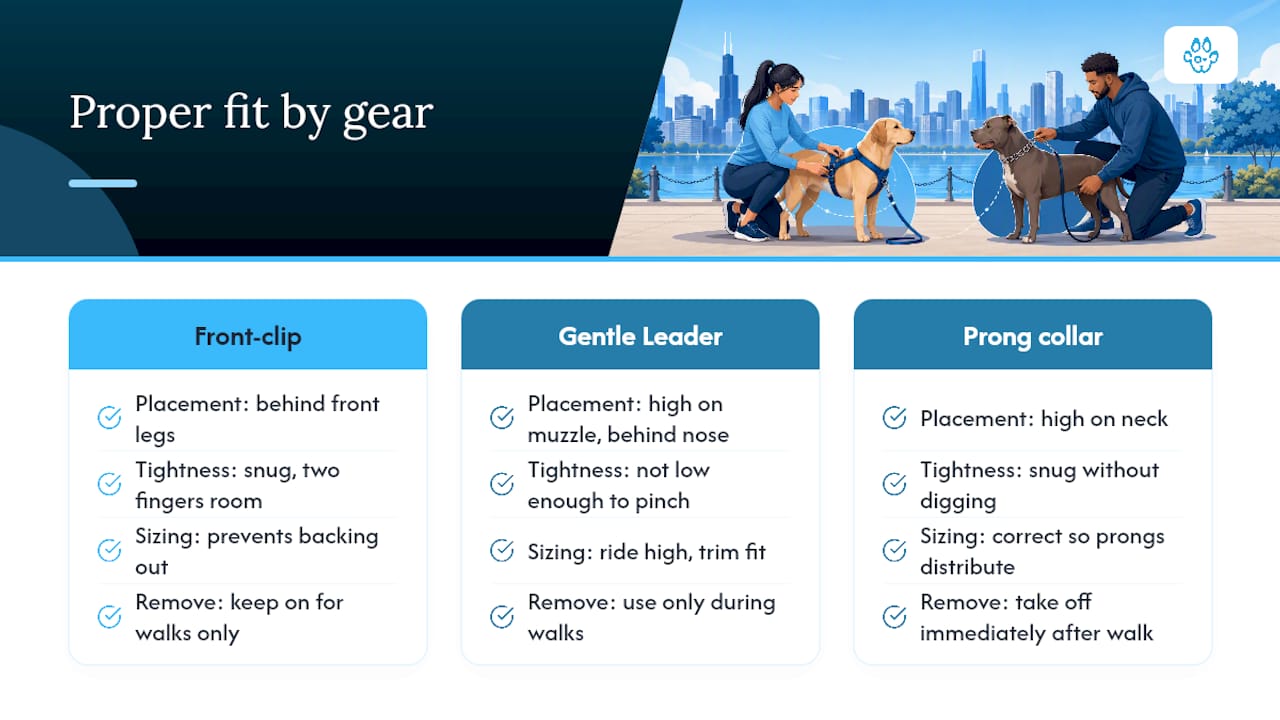
A properly fitted front-clip harness sits snug behind the front legs with room for two fingers underneath, no gaps that let a dog back out. A Gentle Leader rides high on the muzzle, just behind the nose, never low enough to pinch the mouth shut. A prong collar, when used under supervision, needs to sit high on the neck, snug without digging in, and correctly sized so the prongs distribute rather than concentrate pressure.
Daily rules matter more than the gear itself: never leave any collar or harness on an unsupervised dog, inspect hardware weekly for bent prongs or frayed straps, and remove prong collars immediately after each walk. Watch for limping, skin irritation, coughing, or sudden leash avoidance. Those are signs to stop and call a professional, not push through.
A reliable leash matters here too. Retractable leashes undermine even the best-fitted harness by giving you far less control exactly when you need it most.
What our walkers actually recommend
Our walkers see hundreds of leashes a week across the North Side, and the pattern is consistent: harness first, training second, prong collars rarely and only under a trainer's eye. We joke that the only thing that should tighten around your dog's neck is their appetite for treats.
"We've walked a lot of big, strong dogs in our time, and the ones who stop pulling are the ones whose people put in months of training, not the ones with the strongest hardware. Honestly though, all dogs need training, and if you aren't up for the task, that's okay, but find someone who can help ASAP! You got this!"
- Michael Jaurigue
When you'd rather hand the leash to someone else
Some pulling problems are not really equipment problems. They are exercise and consistency problems, and no harness fixes a dog who is simply under-stimulated. If your dog needs more miles than your schedule allows, Sparky Steps offers dedicated dog running services across the North Side, matching high-energy dogs with the same trusted walkers every time, not a rotating cast of strangers from an app.
We are not in the business of selling collars or harnesses. We are the alternative to figuring out pulling problems alone: a consistent care team who already knows how to read your dog's body language on a walk, backed by real-time updates through DoTimely so you know exactly how the walk went. If your dog's pulling is really an exercise or consistency issue, book a visit and let a trusted walker take it from here.
Key takeaways
- Start with asking a trainer or veterinarian for advice about your dog's situation.
- It's recommended to start with a front-clip, non-tightening harness for most dogs; it's the safest first move.
- Prong collars carry documented welfare and medical risks and belong only in narrow, trainer-supervised cases.
- Fit and training matter more than which device you buy.
- Back-clip harnesses work for calm walkers but can backfire for food-motivated pullers.
- Hiring a trained, consistent walker can reduce or eliminate the need for aversive tools altogether.
| Situation | Best starting tool |
|---|---|
| Mild puller, puppy, or small dog | Front-clip harness |
| Brachycephalic breed or neck issue | Harness only, no neck pressure |
| Strong adult puller | Front-clip harness or Gentle Leader with training |
| Anxious or reactive dog | Harness or head collar, not a prong collar |
Sources
- Johnson and Wynne, comparative study of leash equipment, PeerJ (2024)
- Shih et al., leash tension and harness vs collar, Frontiers in Veterinary Science (2021)
- Cavalli and Protopopova, review of collars, harnesses, and head collars, Animals (2025)
- Pet Professional Guild: choke and prong collars health concerns
FAQ
Why do dog trainers not like harnesses?
Most trainers don't dislike harnesses broadly; the concern is specifically with back-clip designs, which some studies show can allow stronger pulling in motivated dogs. Front-clip harnesses don't carry the same criticism.
What are the downsides of using a prong collar on a dog?
Prong collars concentrate pressure on the neck, which carries documented risks including injury, spikes in eye pressure, and a chance of escalating fear or aggression if used incorrectly or on the wrong dog.
Do vets recommend collars or harnesses?
Vets generally recommend harnesses, especially for brachycephalic breeds, dogs with neck or heart conditions, and puppies still growing into their bodies.
Why use a harness instead of a collar?
A harness distributes pressure across the chest and shoulders instead of the throat, which lowers injury risk and works well alongside training for dogs that pull. For Chicago pet parents who would rather address pulling through consistent walks and hands-on attention, professional dog running services offer a training-friendly alternative to leaning on equipment alone.
Is a prong collar safe for all dogs?
No. Prong collars are not appropriate for puppies, brachycephalic breeds, anxious or reactive dogs, or any dog with a known neck issue, and even for suitable dogs, professional guidance advises against routine use.


