

A pet care profile is a structured, comprehensive record that centralizes everything a caregiver needs to provide safe, consistent, and personalized care for your pet. Think of it as the instruction manual your fur baby deserves, covering identity basics, daily routines, medical details, and behavioral quirks all in one place. For urban pet parents managing busy schedules and multiple caregivers, a well-built profile is the difference between a caregiver who guesses and one who genuinely knows your pet. Profiles serve as both an instruction manual and personality guide to ensure every visit follows your pet’s routine and safety needs. If your pet could write their own bio, this is exactly what they’d want you to create for them.
What is a pet care profile, and what does it include?

A pet care profile is the organized, written record that converts everything you know about your pet into a format any caregiver can use immediately. Without it, every new walker or sitter starts from scratch, relying on memory, guesswork, and a prayer. Incomplete or ambiguous profile info increases risk when multiple caregivers fill in the gaps. That risk is real, especially in urban settings where your pet might see two or three different walkers in a single week.
A thorough pet care profile covers six core categories:
- Identity basics: Full name, nickname, species, breed, age, weight, and a clear photo. Include any microchip or license numbers here.
- Daily routine and preferences: Feeding times, portion sizes, preferred walk routes, play preferences, and nap habits. Exact timing matters more than you think.
- Medical details: Current conditions, medications with dosages and schedules, known allergies, and your primary vet’s contact information plus an emergency vet backup.
- Behavioral notes: Temperament, fear triggers, training cues your pet responds to, and any known aggression or anxiety patterns. “Nervous around skateboards” is genuinely useful information.
- Emergency contacts: Your contact info, a secondary emergency contact, and any designated caregivers authorized to make decisions.
- Supplemental media: A short video showing how your dog takes medication or how your cat prefers to be handled can clarify things that words alone cannot.
Pet care software separates client profiles from pet profiles to maintain detailed, per-animal records within a household. That structure matters because your golden retriever and your rabbit have completely different care needs, and mixing their records creates confusion fast.
How to create and maintain an accurate pet care profile
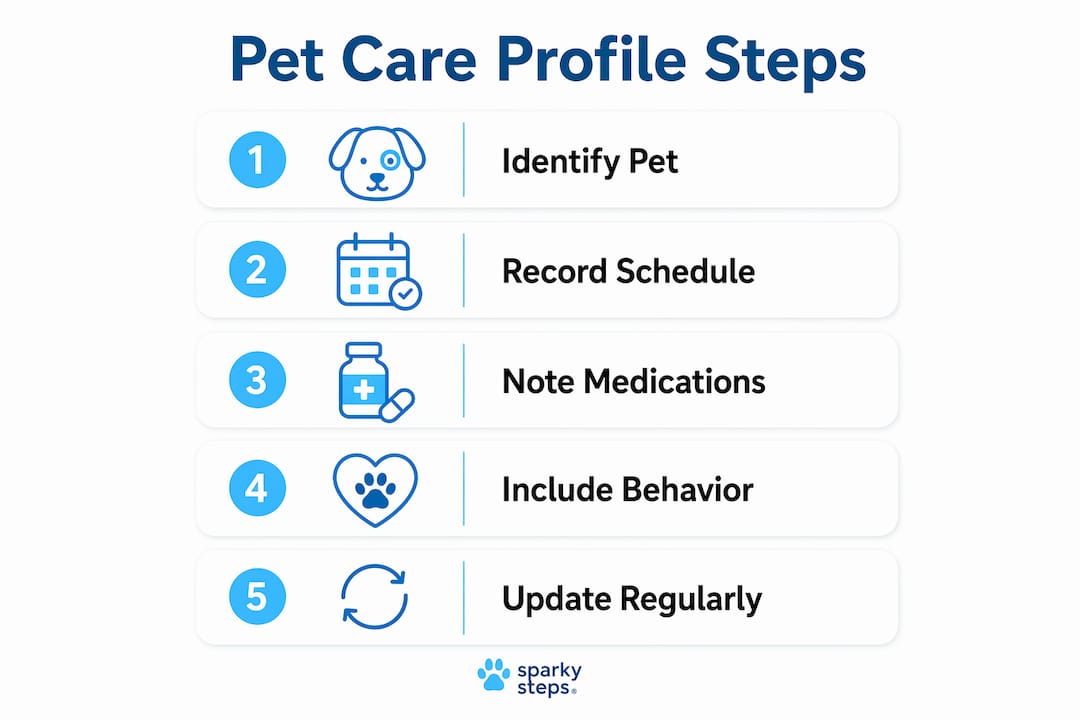
Building a solid profile takes about an hour the first time. Maintaining it takes five minutes after any significant change. Here is a practical process to get it right.
- Start with a checklist. Gather your pet’s vet records, medication bottles, and any care notes you have already written. A checklist prevents you from skipping the details that seem obvious until they are not.
- Write with a stranger in mind. Describe your pet’s routine as if the reader has never met them. “Feed at 7 a.m. and 5 p.m., one cup each time, no table scraps because she will beg convincingly” is far more useful than “feed twice a day.”
- Specify behavior triggers precisely. Note what sets your pet off and what calms them down. “Barks at delivery trucks but settles within two minutes if you redirect with a sit command” gives a caregiver a clear action plan.
- Use a digital tool designed for pet profiles. Apps like DoTimely, which Sparky Steps uses for every visit, allow you to store profile details, share them with your care team, and receive real-time updates after each visit. Digital profiles are searchable, shareable, and harder to lose than a paper note on the fridge.
- Treat the profile as a living document. Pet care instructions require regular updates to remain accurate as your pet’s needs change. After a new diagnosis, a medication change, or even a shift in feeding schedule, update the profile within 24 hours.
- Ask your regular caregivers for input. Your walkers notice things you might miss. If your dog has started showing anxiety on certain routes, that belongs in the profile.
Pro Tip: Date every update at the top of your profile. A caregiver who sees “Last updated: march 2024” knows to ask whether anything has changed. A profile with no date gets treated as gospel, even when it is two years out of date.
Why a pet care profile benefits both pet parents and caregivers
A well-built profile does more than organize information. It actively improves the quality of care your pet receives and reduces stress for everyone involved.
- Transfers knowledge from memory to a repeatable system. Groomers describe profiles as converting scattered notes into consistent care data, improving safety and personalization across every visit. Your pet gets the same quality of care whether you are in a meeting or on a flight to Denver.
- Reduces caregiver guesswork. Detailed profiles that specify exact feeding times, behavior triggers, and normal behaviors reduce decision-making errors during visits. A caregiver who knows your cat normally hides for the first ten minutes is not going to panic and call you unnecessarily.
- Builds trust between pet parents and caregivers. Specific, detailed profiles build owner confidence far more effectively than vague reassurances. When a caregiver can reference your profile and say “I followed the exact routine you outlined,” that is trust built on evidence.
- Improves emergency response. Emergency profiles must include medical constraints and behavioral considerations so temporary caregivers or finders can provide appropriate care immediately. A lost dog with a QR code linked to a complete profile gets reunited and cared for faster than one with just a phone number on its tag.
- Supports consistency across multiple caregivers. Urban pet parents often rely on a primary walker, a backup, and an occasional pet sitter. A shared profile keeps all three aligned without requiring you to repeat yourself every time.
- Helps meet professional care standards. Many professional pet care services, including licensed and insured operations, require detailed profiles before beginning care. It is a sign of a serious provider, not unnecessary paperwork.
Pet care profile examples and how to tailor them for your pet
Profile templates vary by pet type, but the structure stays consistent. Here is how the format adapts across common scenarios.
Dog profile example: Name: Biscuit. Breed: Beagle mix, 4 years old, 28 lbs. Feeding: 7 a.m. and 5 p.m., one cup of dry kibble. Walk: 30 minutes, avoid the alley on Damen because of the loose fence boards. Behavior: Friendly with people, reactive to small dogs on leash. Cue: “Leave it” works reliably. Vet: Dr. Patel at Andersonville Animal Hospital, (773) 555-0192.
Cat profile example: Name: Duchess. Indoor only. Feeding: Free-fed dry food, wet food at 6 p.m. Litter: Scooped daily, she will protest loudly if you forget. Behavior: Shy with strangers, warms up after 20 minutes. Do not pick her up; she prefers to come to you.
Small animal example: Name: Pepper. Species: Guinea pig. Feeding: Fresh hay always available, leafy greens at 8 a.m., no iceberg lettuce. Handling: Gentle, scoop from below. Signs of stress: Teeth chattering means back off.
For digital profiles, tag codes linked to online pet profiles allow finders and temporary caregivers to access care instructions and emergency contacts instantly via a scan. This is particularly useful for urban dogs who spend time in busy parks and neighborhoods.
| Profile type | Best for | Key customization |
|---|---|---|
| Basic paper profile | Single caregiver, simple routine | Keep it to one page, laminate it |
| Digital app profile | Multiple caregivers, frequent updates | Use DoTimely or similar for sharing |
| QR/NFC tag profile | Emergency and lost-pet scenarios | Link to emergency contacts and medical info |
| Species-specific template | Small animals, reptiles, birds | Include habitat, temperature, and handling notes |
Pro Tip: Add a “What normal looks like” section to your profile. Describe your pet’s typical energy level, appetite, and bathroom habits. A caregiver who knows your dog usually eats enthusiastically will flag a skipped meal as a potential health concern, not just a picky day.
Key Takeaways
A pet care profile is the single most effective tool for ensuring consistent, safe, and personalized care across every caregiver who interacts with your pet.
| Point | Details |
|---|---|
| Define the profile clearly | A pet care profile centralizes identity, routine, medical, and behavioral info in one accessible record. |
| Update it regularly | Treat the profile as a living document and revise it within 24 hours of any change in routine or health. |
| Specify, do not generalize | Exact feeding times, behavior triggers, and normal baselines reduce caregiver errors significantly. |
| Go digital for multi-caregiver households | Digital profiles via tools like DoTimely allow sharing, real-time updates, and consistent access. |
| Emergency info is non-negotiable | Include medical constraints, behavioral notes, and vet contacts so any caregiver can act immediately. |
Why I think most pet parents wait too long to build a profile
I have been working with Chicago pet parents since 2016, and the pattern I see most often is this: pet parents build a profile after something goes wrong. A caregiver gives the wrong portion size. A dog has a reaction to a food the walker did not know was off-limits. A cat hides for three hours because no one knew she needed a quiet intro period.
The profile is not a bureaucratic formality. It is the thing that keeps your pet safe when you are not there. And in an urban environment like Chicago’s North Side, where a pet might interact with two or three different walkers in a week, the stakes of an incomplete profile are higher than most people realize.
What I have also noticed is that vague profiles create vague care. “She’s friendly” tells a caregiver almost nothing. “She’s friendly with adults but nervous around children under ten, and she settles with a ‘place’ command” gives them a real tool. Specific trust signals and care details build genuine confidence, not just reassurance.
My honest advice: build the profile before you need it, review it every three months, and share it with every person who enters your home for your pet. It takes less time than you think, and it pays off every single visit. You can also check out our trustworthy pet sitter checklist to understand what good caregivers look for in a profile when they first meet your pet.
— Michael Jaurigue
How Sparky Steps puts your pet’s profile to work
At Sparky Steps, every pet parent who joins our care team builds a detailed profile before the first visit. Our walkers use DoTimely to access that profile, log real-time updates, and send GPS-tracked visit notes directly to you after every single visit. You are never left wondering what happened while you were at work. Our care team has served 250+ Chicago pet parents across neighborhoods like Andersonville, Ravenswood, and Edgewater, and the profile is the foundation of every relationship we build.
Whether your pet needs consistent dog walking in Chicago or dedicated pet sitting at home, the profile is what allows our walkers to show up prepared, confident, and genuinely connected to your pet’s needs. Licensed, bonded, and insured, the Sparky Steps care team treats your fur baby like a neighbor’s kid, not a transaction.
FAQ
What is a pet care profile?
A pet care profile is a structured record centralizing a pet’s identity, routine, medical details, and behavioral notes for any caregiver to reference. It functions as both an instruction manual and a personality guide for consistent, safe care.
What should I include in a pet care profile?
Include your pet’s name, breed, age, feeding schedule, medical conditions, medications, vet contacts, behavior triggers, training cues, and emergency contacts. Adding photos or short videos improves clarity for new caregivers.
How often should I update my pet’s profile?
Update the profile within 24 hours of any change in routine, health, or medication. A dated profile that no one updates becomes a liability, not an asset.
Why is a pet care profile important for urban pet owners?
Urban pet parents often rely on multiple caregivers across a week. A complete profile keeps every caregiver aligned without requiring repeated verbal briefings, reducing errors and improving your pet’s consistency of care.
Can a pet care profile help in an emergency?
Yes. Emergency profiles that include medical constraints and behavioral notes allow finders or temporary caregivers to provide appropriate care immediately, which is critical when time and context are limited.
Written by the Sparky Steps Team.
Authorship Note
The content above aligns with the values of Sparky Steps LLC. While our trusty artificial intelligence helped organize the article, whip up some fun images, and translate ideas into clear, practical language, the final masterpiece is a delightful collaboration between passionate human writers who adore animals and a sprinkle of artificial intelligence magic. Remember, if you think writing is easy, try typing with paws!


