


Enzyme cleaners are good at one specific job: breaking down organic pet stains and their odor at the source, not just covering them up. The catch is patience, enzymes need real dwell time, and they are not disinfectants. But here is the twist: Consumer Reports' own 2026 head-to-head lab test found the top overall performers on real dog urine were not enzyme formulas at all. Enzymes are still a genuinely good tool. They are just not automatically the best one for every situation.
TL;DR:
- Enzyme cleaners are slower than oxidizers but effective at eliminating organic pet stains and odors at the source, with dwell time ranging from minutes for fresh stains to up to 24 hours for tough, set-in ones.
- They rely on moisture and contact time to break down proteins, uric acid, and fats, making proper application crucial for results.
- Enzyme products are not disinfectants and do not work on non-organic stains like ink or mineral deposits, which require different cleaning agents.
- A 2026 Consumer Reports lab test found oxidizers and bio-enzymatic blends actually outperformed pure enzyme formulas on real dog urine, a genuinely useful finding most guides leave out.
- For old or deeply set stains, enzyme cleaners may be ineffective if the stain has reached the subfloor, warranting professional remediation.
Enzyme cleaner vs regular cleaner: how the science actually works
Enzymes are biological catalysts. That is the official definition from the National Human Genome Research Institute, and it is a fancy way of saying enzymes speed up a chemical reaction without getting used up themselves. In a cleaning product, that reaction targets the exact molecules pets leave behind: proteins, uric acid, and fats.
Regular cleaners rely on physical action or harsh chemistry. Enzyme cleaners work more like a biological demolition crew, breaking large stubborn molecules into small water-soluble pieces that rinse away instead of lingering in carpet fibers.
Three enzyme types do most of the heavy lifting:
- Protease breaks down proteins from blood, vomit, and food stains.
- Urease attacks the uric acid crystals in dried dog and cat urine, which is why old pet stains keep smelling long after they look dry.
- Lipase dissolves fats and grease, useful for pet vomit or cooking spills.
Here is the part most bottles do not explain on the label: enzymes need moisture and time to keep working. A dry enzyme is a dormant enzyme. Once the area dries out, the reaction stops, whether it finished the job or not.
What Consumer Reports actually found when they tested this head to head
Most articles about enzyme cleaners treat them as the automatic winner. Consumer Reports actually tested that assumption, applying nine popular sprays to carpet stained with real dog urine and fabric treated with onion juice, and measuring the results. The headline finding surprised even them: the top performers in both tests were not pure enzyme formulas. They were hydrogen peroxide oxidizers, bio-enzymatic blends that combine safe bacteria with enzymes, and one plant-based surfactant.
Consumer Reports' own conclusion is a genuinely fair one worth repeating directly: no single formula type is universally better, each has real tradeoffs. Enzyme cleaners need longer dwell time but tend to be biodegradable and gentler on surfaces. Oxidizing cleaners work faster and disinfect, but ingredients like hydrogen peroxide are not safe for every surface and did not always fully eliminate odor in their testing.
Enzyme cleaner vs regular cleaner: what each one actually does best
Think of your cleaning cabinet as having three different tools for three different jobs, not one universal fix.
Enzyme cleaners dig out organic stains and eliminate odor at the molecular source, but they work slowly, and dwell time depends heavily on how deep and how old the stain is. A fresh accident on a hard surface may only need minutes. An old, set-in stain in carpet padding can call for several hours, sometimes up to a full day.
Oxidizers and bleach remove visible stains fast and disinfect at the same time. Consumer Reports' own testing found oxidizing products can outpace enzymes on speed and, in some cases, on overall stain and odor removal, though they do not always finish the job on lingering odor the way a well-applied enzyme treatment can.
Surfactant cleaners (your standard all-purpose sprays) lift surface dirt and grime well but do nothing to break down proteins or uric acid buried in carpet padding.
A quick breakdown:
- Enzymes: slower, gentler on fabrics, generally biodegradable, best when you can give them real time to work.
- Oxidizers: fast, disinfects, can bleach or discolor fabrics and dyes.
- Surfactants: quick surface cleanup, useless against set-in organic stains.
You can combine approaches, but order matters. Treat with enzymes first, let them finish working, then disinfect afterward if you need to. Doing it in reverse, bleaching before the enzymes finish, can undo the entire treatment before it starts.
Which cleaner to use for common pet situations
Not every accident calls for the same response. Match the mess to the method:
- Fresh accidents on carpet or upholstery. Blot up as much liquid as possible with a clean towel, then saturate the area with an enzyme cleaner while it is still fresh. The sooner you treat it, the less time uric acid has to bond with fibers.
- Old or set-in urine stains. These need a heavier soak and longer dwell time. If the stain has been there for weeks and the odor still returns after cleaning, the urine may have reached the carpet pad or subfloor, and professional remediation may be the only real fix at that point.
- Hard floors like tile or sealed wood. Regular cleaners or diluted oxidizers are usually fine here since there is no fabric or padding to trap odor deep down.
- Laundry and drains. Enzyme cleaners are not just for carpets. Pouring a bit down a smelly drain or adding an enzyme laundry booster to soiled bedding tackles the same organic buildup that causes odor everywhere else.
If your dog has a habit of finding the same crate corner, it is worth revisiting your crate training routine alongside the cleanup. Sometimes the mess is a training issue wearing a laundry-day disguise.
How to apply enzyme cleaner the right way
Getting real results from an enzyme cleaner is less about the product and more about the process. Follow these steps in order:
- Remove solids and blot excess liquid. Do not scrub. Scrubbing pushes the mess deeper into carpet fibers instead of lifting it out.
- Skip the hot water. Heat denatures enzymes the same way it cooks an egg white. Cold or room temperature water only.
- Saturate generously. Pour or spray enough enzyme cleaner to match the volume of the original accident, not just a light misting on top.
- Keep it moist. Covering the treated spot with a damp cloth or plastic wrap slows evaporation and extends the working window, a trick worth using on tougher, older stains.
- Let it sit, following the label's specific guidance, anywhere from a few minutes for a fresh, light stain up to several hours or overnight for something old and set-in, then blot dry as directed.
- Re-treat if odor lingers. A second application is normal for older or larger stains. If the smell keeps returning after multiple treatments, the padding or subfloor is likely involved, and that is a job for a flooring professional.
- Disinfect only after the enzymes finish. If you want to kill germs too, wait until the enzyme treatment is done drying, then apply a pet-safe disinfectant separately.
One habit worth building in: keep a spray bottle of your enzyme cleaner and a stack of old towels near your pet's favorite napping and eating spots. Fast action on a fresh accident saves hours of dwell time later, since fresh stains generally need far less time to treat than ones that have had a chance to set in.
Safety notes and realistic limits of enzyme cleaners
Enzyme cleaners are not a cure-all, and treating them like one leads to disappointment. A few limits worth knowing before you reach for the bottle:
- They do not disinfect. If pathogen reduction matters (say, a household with a new puppy or an immune-compromised family member), let the enzyme treatment fully finish, then follow with a pet-safe disinfectant.
- Non-organic stains are a dead end. Ink, dye, rust, and mineral deposits are not made of proteins or fats, so enzymes have nothing to break down.
- Heat and harsh chemicals ruin the batch. Never pre-treat with bleach, ammonia, or hot water before applying an enzyme cleaner. You will denature the enzymes before they get to work.
- Let it dry fully before pets or kids return to the area, and always follow the product label's specific warnings and ventilation instructions.
Where the evidence and lab tests come from
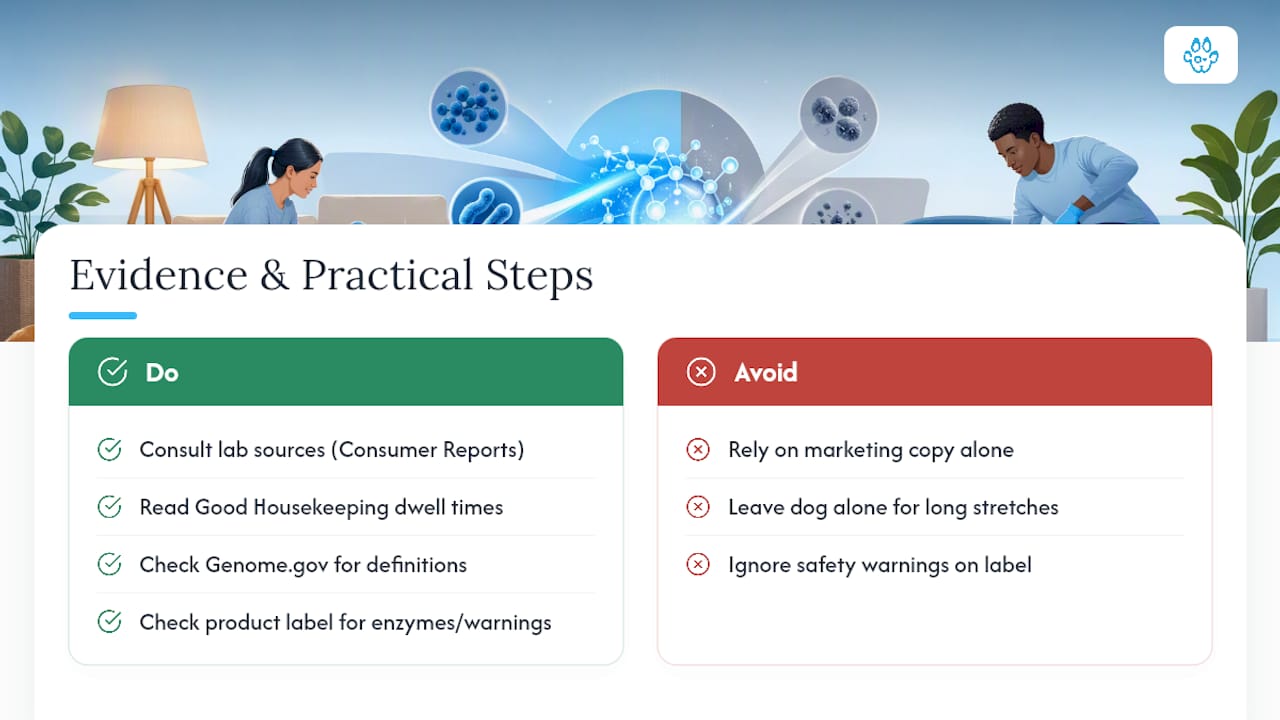
The claims here draw from real testing, not marketing copy. Consumer Reports compared enzyme cleaners against oxidizers head to head on real dog urine and produced results that complicate the simple "enzymes always win" narrative. Good Housekeeping Institute runs hands-on product testing with dwell time notes. The National Human Genome Research Institute offers the scientific baseline definition for what an enzyme actually is. Always check your product's label for the specific enzyme types listed and any safety warnings before you buy.
If your dog is a repeat offender and you are tired of playing cleanup crew solo, sometimes the better fix is more consistent supervision. Sparky Steps offers pet sitting in Chicago with the same trusted walkers every visit, backed by real-time updates through DoTimely, so accidents caused by long stretches alone become less frequent in the first place. Happy to help if we can and happy cleaning, you got this!
Sources
- The best spray for tackling pet stains and odors is not an enzyme cleaner, Consumer Reports
- Best enzyme cleaner, Good Housekeeping Institute Home Care and Cleaning Lab
- What is an enzyme cleaner? The Spruce
- Enzyme, National Human Genome Research Institute
FAQ
Is white vinegar an enzymatic cleaner?
No. White vinegar is an acid that can neutralize some odors and mild alkaline residue, but it contains no enzymes and will not break down proteins or uric acid the way a true enzyme cleaner does.
What are the downsides of using enzymes?
The main downside is speed: enzyme cleaners need real dwell time and they will not disinfect or work on non-organic stains like ink or rust.
Is OxiClean considered an enzymatic cleaner?
No. OxiClean is an oxidizing cleaner, not an enzyme formula. It works faster on visible stains and can disinfect, but it does not target organic matter at the molecular level the way protease, urease, and lipase do.
Do enzyme cleaners actually clean?
Yes, when used correctly, though a 2026 Consumer Reports test found the top overall performers were not enzyme formulas. Enzyme cleaners break down the proteins and uric acid in pet stains into water-soluble byproducts, which is why they can eliminate odor at the source, provided you give them enough moisture and time to finish the job.


