

A pet sitter background check verifies identity and screens for criminal-history red flags, but it’s a baseline, not a guarantee of good care. Treat a clean report as step one, not the finish line: pair it with references, a meet-and-greet, proof of insurance, and real visit updates. That’s exactly how Sparky Steps builds trust with every family we walk for, with licensed, bonded, and insured walkers who show up consistently and send you photos and GPS notes after every single visit.
TL;DR:
- A comprehensive pet sitter background check includes identity verification, multi-state criminal searches, county records, sex offender registry, and motor vehicle records.
- Automatic disqualifiers involve sex offender registry hits, animal cruelty convictions, and violent felonies, while past nonviolent offenses are evaluated case-by-case.
- Federal laws require disclosure and consent for third-party checks when a company conducts screening, but individual hiring processes may lack these protections.
- Costs vary from inexpensive, quick basic searches to more expensive, in-depth bundle checks that can take several days to weeks, with rechecks recommended every one or two years.
- Background checks do not assess critical caregiving skills like administering medication or recognizing pet health issues, which must be verified through operational transparency and certifications.
What does a pet sitter background check actually include?
A proper pet sitter background check pulls from several databases, not just one quick search. Here’s what a thorough screening typically covers, based on how professional screening services and pet-care background check tools approach it.
- Identity verification (SSN trace): confirms the person is who they say they are and surfaces past names and addresses, which helps investigators know where else to search for records.
- Multi-state criminal database search: casts a wide net across jurisdictions, since someone with a record in one state might have moved without leaving a local trace.
- County-level criminal record checks: the most reliable layer, since county courthouses hold the actual case records that national databases sometimes miss or report with a lag.
- National sex offender registry search: a non-negotiable check for anyone entering a pet parent’s home.
- Motor vehicle records: relevant when a sitter drives pets to the vet, a groomer, or a dog park, since a suspended license or reckless-driving pattern matters.
- OFAC and global watchlist checks: less common for individual sitters but standard for larger pet sitter background check vendors serving companies.
ACUTRAQ, a screening provider that builds pet-care-specific background reports, bundles most of these into a single shareable file, which is worth asking about if you’re comparing independent sitters.
What disqualifies a pet sitter from being hired?
Some findings end the conversation immediately. Others get weighed in context. Knowing the difference helps you ask smarter questions instead of panicking over a decade-old traffic ticket.
Automatic disqualifiers, for almost any responsible pet-care company, include:
- A hit on the national sex offender registry
- Convictions for animal cruelty or animal abuse
- Violent felonies, including assault or battery
Issues that usually trigger a closer look rather than an automatic no:
- Theft or drug-related felonies within the past several years
- Multiple driving offenses, if the role involves transporting pets
- A pattern of recent, unresolved legal trouble
The EEOC’s guidance for employers is worth knowing here: it discourages blanket bans and calls for an individualized assessment, weighing the nature of the offense, how long ago it happened, and its relevance to the job. A misdemeanor from 15 years ago rarely says much about someone’s trustworthiness today. A recent, related, or violent offense says a lot.
What are the legal basics behind a background check?
If a company (rather than you personally) is running the check, federal law shapes how it can happen. The Fair Credit Reporting Act requires clear disclosure to the candidate and written consent before any third-party check runs. If a report leads to a “no hire” decision, the company generally has to walk through a pre-adverse and adverse action process, giving the candidate a chance to respond.
Here’s the distinction pet parents often miss:
- When a company hires a sitter: the FCRA applies, and the company carries disclosure and consent obligations.
- When you personally hire an independent sitter: you’re not bound by the same federal framework, but running a check without the person’s knowledge is still a bad look and often against the screening vendor’s own terms.
- State-level rules vary: some states restrict how far back a criminal record can be reported, and sealed or expunged records generally can’t surface on a legitimate check at all, per privacy-rights guidance on report limits.
How much does a background check cost, and how long does it take?
Cost and speed depend heavily on how deep the search goes. A basic identity and single-state criminal search runs cheap and fast. A full multi-state, county-level, sex offender, and motor vehicle bundle costs more and takes longer to compile, especially if county courthouses process requests by mail rather than digitally.
Turnaround time by result type
| Result type | Typical turnaround |
|---|---|
| Clean report, no flags | a few days |
| Flagged record needing manual review | several business days |
| Complex cases (multiple aliases, out-of-state records) | several weeks |
According to DogWalkJobs’ breakdown of dog walker screening, clean checks typically clear in a day or two, while anything flagged for human review takes noticeably longer. That gap matters if you’re hiring on short notice. It’s a good reason to ask a provider when the sitter’s most recent check was completed, not just whether one ever happened.
Recheck frequency is where a lot of pet parents get surprised. A background check isn’t a one-time stamp of approval. The Better Business Bureau notes that some screening arrangements get re-run annually, while other direct-hire companies recheck every two years. Either way, periodic rechecks matter because someone’s record can change after their first day on the job, and a provider that never re-screens is basically running on a five-year-old snapshot.
Costs are usually absorbed by the company doing the hiring, not passed on to you as a line-item fee. If you’re vetting an independent sitter yourself and paying for the check out of pocket, budget for the deeper multi-state and county-level option. The cheap, instant-results searches you see advertised online often skip county records entirely, which is exactly where the most reliable data lives.
What background checks miss (and why it matters more day to day)
Here’s the part nobody advertises: a spotless criminal record tells you nothing about whether someone can calm a panicking dog during a thunderstorm, spot the early signs of bloat, or give a cat its insulin shot on schedule. Background checks screen out bad actors. They don’t screen in good caregivers.
The skills that actually determine whether your pet is safe and happy rarely show up on a report:
- Comfort administering medication, from pills to insulin to eye drops
- Judgment under pressure, like recognizing when a limp needs a vet visit versus rest
- Species-specific know-how, since a guinea pig’s needs look nothing like a Labrador’s
- Reading a nervous or reactive animal’s body language before it escalates
Operational signals fill that gap. Ask whether the sitter or company is licensed, bonded, and insured, whether anyone on the team holds pet first-aid and CPR certification, and whether a meet-and-greet or trial visit happens before the real booking starts. GPS-tracked visits with photos and notes add a layer that a background check simply can’t: proof of what actually happened at 2:15 p.m. on a Tuesday while you were stuck in a meeting.
Industry groups like the IBPSA frame background screening as one piece of a broader safety program, alongside insurance verification and in-person vetting. A clean report plus zero operational transparency is a half-finished picture. A clean report plus insurance, certifications, and consistent visit documentation is the real thing.

How do you ask a pet sitter service the right questions?
Most reputable providers will answer these without hesitation. Hesitation itself is information.
- Ask what checks are run and by whom. A specific answer (SSN trace, county records, sex offender registry) beats a vague “yes, we do background checks.”
- Ask when the sitter’s check was last updated. If nobody can tell you, that’s a gap.
- Ask for proof of insurance and bonding, not just a verbal confirmation.
- Ask about certifications, like pet first-aid, CPR, or fear-free handling training.
- Ask for references from current or recent clients, and actually call them.
Pro Tip: Ask “what happens if my dog gets loose or has a medical emergency during a visit?” Their answer reveals more about preparedness than any certificate on the wall.
Red flags worth walking away from: evasive answers about screening, refusal to do an in-person meet-and-greet, no references available, no visit updates promised, and no insurance. A short hiring checklist keeps you honest: verify credentials, schedule a meet-and-greet, book a trial visit, write down a care plan (feeding times, meds, quirks), and confirm emergency contacts before the first real booking.
How does Sparky Steps vet its walkers beyond a background check?
Every Sparky Steps walker is part of a licensed, bonded, and insured team, and each one carries their own certified Pet Care Insurance rather than relying on a single blanket policy. That’s not a technicality. It means there’s real coverage behind every visit, not just a background check on file somewhere.
Founder Michael Jaurigue is a Fear Free Certified Professional (FFCP) and holds credentials through Pet Sitters International (CPPS) and the National Association of Professional Pet Sitters (NAPPS), which shapes how the whole care team is trained to handle nervous or reactive pets using positive reinforcement.
Here’s what fills the gap a background check leaves open:
- The same trusted walkers every time, so your dog isn’t meeting a new stranger every visit
- Real-time updates through DoTimely: GPS tracking, photos, and notes after every single visit
- A care team trained in fear-free, positive-reinforcement methods, not just cleared by a records search
- A community-based model built on ten years of referrals across the North Side, rather than a rotating pool of app-dispatched strangers
A background check answers “is this person safe to let into a home.” Consistency, insurance, and documented visits answer the harder question: “will this person actually take good care of my dog on a random Wednesday.”
How do you read a background check report without overreacting?
A report full of technical codes and database names can look scarier than it is. Start by separating what’s disqualifying from what’s just old paperwork. A single misdemeanor from 12 years ago with nothing since is a different story than three arrests in the past two years.
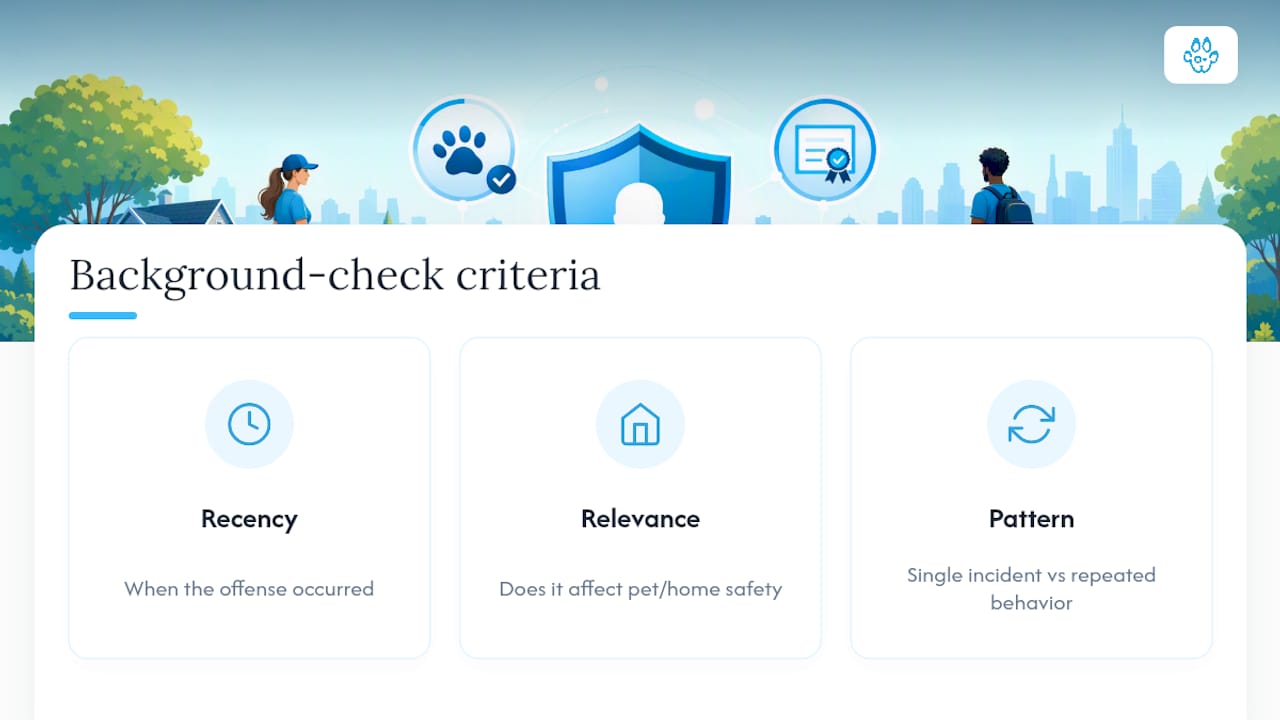
Look at three things: recency, relevance, and pattern. Recency asks how long ago the incident happened. Relevance asks whether the offense connects to pet care or home access, like theft or animal cruelty, versus something unrelated, like an old unpaid parking ticket that ballooned into a misdemeanor. Pattern asks whether you’re looking at one incident or a repeated behavior.
Genuine red flags don’t need much interpretation: a sex offender registry hit, an animal cruelty conviction, or a violent felony should end the process immediately, full stop. Gray areas, like a decade-old nonviolent misdemeanor, deserve a conversation rather than an automatic rejection, which is exactly the individualized-assessment approach the EEOC recommends for employers making these calls.
One more thing worth checking: does the report include a name-only search, or did it verify identity first with an SSN trace? A name-only search on someone with a common name can either miss real records or falsely flag the wrong person. If a provider can’t explain how they confirmed identity before pulling criminal history, ask again.
How is background check data kept private and secure?
A background check pulls sensitive information: Social Security numbers, address history, criminal records. Where and how that data gets stored matters just as much as what the report says.
Reputable screening providers only share reports with the parties who have a legitimate need to see them and delete or restrict access to old files rather than keeping them sitting in an inbox indefinitely. If you’re hiring an independent sitter and running a check yourself, ask the screening service how long they retain your report and who else can access it.
Consent matters here too. Running a check on someone without their knowledge, even out of caution, is both a legal gray area in many states and simply not a great way to start a working relationship built on trust. The disclosure-and-consent process built into the FCRA exists partly for this reason: transparency about who sees what.
Sealed and expunged records are legally protected and shouldn’t appear on a compliant report at all. If a check somehow surfaces something that should have been sealed, that’s a sign the screening provider isn’t following proper protocol, and it’s worth asking hard questions about where else your data might be ending up.
A quick, honest note from the Sparky Steps team
Background checks matter. We wouldn’t skip them. But they’re the floor, not the ceiling, and pet parents deserve to know that difference before they hand over their house key.
“A clean background check tells you someone probably won’t hurt your dog. It doesn’t tell you they’ll notice the limp before it’s a vet bill. That takes real care, not just a clean record.”
— The Sparky Steps Team
Want a fully vetted team without doing all this legwork yourself?
There are good reasons to run your own checks on an independent sitter, and now you know exactly what to ask for. But if you’d rather skip the vendor comparisons and paperwork, Sparky Steps has already done that homework for you, and kept doing it for ten years. Every walker on our team is licensed, bonded, and insured, and the vetting doesn’t stop at a clean report: we layer in fear-free training, consistent assigned walkers, and real-time visit updates through DoTimely so you’re never wondering what actually happened during the visit.
Explore our pet sitting services in Chicago to see how it works, or check out our pet care safety practices for the full rundown on certifications and insurance. If your dog needs more than a walk around the block, our dog running service burns off extra energy with the same trusted face. Ready to meet your future walker? Schedule a meet-and-greet and see the difference a consistent care team makes.
Where to verify these facts yourself
For readers who want to check the legal and industry details firsthand: the FTC’s guidance on consumer reports explains disclosure and consent requirements plainly. The EEOC’s background check guidance covers individualized assessment standards. DogWalkJobs’ screening breakdown details what specific checks typically involve and how long they take. The IBPSA’s vetting guide rounds out the picture with industry-standard safety recommendations for pet parents.
Sources
- Using consumer reports: What employers need to know | FTC
- Background checks: What employers need to know | EEOC
- Dog walker background check: what they look for | DogWalkJobs
- A pet parent’s guide to vetting your care provider | IBPSA
FAQ
What will disqualify you on a pet sitter background check?
A hit on the sex offender registry, an animal cruelty conviction, or a violent felony are near-universal automatic disqualifiers. Older nonviolent misdemeanors are usually reviewed in context rather than triggering an automatic rejection.
What disqualifies someone from being a pet caregiver specifically?
Beyond the criminal record basics, providers look for a history connected to animal welfare: cruelty convictions, animal neglect findings, or a pattern of unreliable, unsafe behavior noted in past references.
Are pet sitters on gig-economy apps background checked?
Many gig-economy platforms run some level of criminal background screening, but the depth and recheck frequency vary widely by company and aren’t always disclosed clearly. Always ask what specific checks were run and how recently, rather than assuming “background checked” means the same thing everywhere.
Should you allow someone to run a background check for a pet-sitting or babysitting job?
Yes. A reputable provider disclosing and requesting consent for a background check, per FCRA requirements, is a sign they take safety seriously, not an invasion of privacy. Refusing outright is a bigger red flag than the check itself.
How often should a pet sitter’s background check be updated?
Practices vary. Some providers recheck annually, others every two years. Ask directly when a sitter’s check was last run, since an outdated clean report tells you very little about today.
Written by the Team.
Authorship Note ., the images, practical language,. Remember, paws!
Recommended
- Signs of a Trustworthy Pet Sitter: Your 2026 Checklist
- Liability Insurance in Pet Care: What It Covers and Why It Matters
- The Ultimate Guide to Preparing your Pet Sitter
- How to Choose a GPS Tracker for Your Dog
The Sparky Steps Team used AI to research and outline this article. A human on the team edited and fact-checked the final text.


