

Most pet sitting and dog walking cancellation policies follow a simple pattern: notice of 7 or more days is usually fully refundable, 24 to 72 hours often triggers a partial charge of 25 to 50%, and same-day cancellations frequently mean the full fee. Holidays and overnight bookings tend to carry stricter rules and non-refundable deposits. Emergencies and severe weather are commonly exceptions. Many pet care providers follow a written policy with booking confirmations and real-time visit updates, so pet parents can know where they stand.
TL;DR:
- Cancellations made more than seven days in advance are typically fully refundable, while cancellations within 24 to 72 hours usually incur a 25% to 50% fee.
- Same-day cancellations often result in a full charge because the time slot is difficult to refill, especially for holiday and overnight bookings.
- Emergency and severe weather cancellations are usually waived if documented properly, but repeated last-minute cancellations are less likely to be excused.
- Providers generally communicate cancellation policies in writing during onboarding, with clear booking confirmations, reminders, and visit records to prevent disputes.
- Using recorded channels for cancellations and keeping documentation ensures enforceability and simplifies disputes over fees.
What notice windows and fee structures should you expect?
Every reputable pet care provider builds its cancellation policy around one goal: protecting the time a walker or sitter has already blocked off for your pet. A written policy doesn’t stop life from happening. It just sets clear expectations so nobody gets stuck holding an empty schedule or an unexpected bill.
Here’s how the notice windows typically break down across the industry:
- 7 or more days ahead: Usually fully refundable, or subject to a small administrative fee at most.
- 24 to 72 hours ahead: Often a partial charge, commonly 50% of the visit cost.
- Same day or no-show: Frequently billed at 100%, since the time slot can rarely be refilled.
- Holiday and peak-period bookings: Often require longer notice, sometimes 14 to 31 days, plus a non-refundable deposit.
Picture two North Side scenarios. If you have a recurring midweek walk and need to cancel Tuesday’s visit by Sunday night, that’s an easy, fee-free change for most providers. But if you booked a week-long overnight stay over Thanksgiving and cancel three days out, you’re looking at a very different conversation. Overnight and holiday bookings hold a slot that’s harder to fill, so providers protect that time more tightly than a single afternoon walk.
When do providers waive cancellation fees?
Nobody wants to charge a fee when your basement is flooding or your dog needs emergency surgery, and most established providers build room for that into how they handle waivers. Common exceptions include:
- A genuine family or pet medical emergency.
- Severe weather that makes travel unsafe.
- Hospitalization of the pet parent or a household member.
Whether a fee actually gets waived usually depends on a few practical factors: how long you’ve been a client, whether the provider can rebook that time slot, the dollar value of the booking, and whether it falls during a holiday window that’s already fully booked. A one-time cancellation from a longtime client during a slow week is an easy yes. A last-minute cancellation of a holiday overnight, especially a repeat offender, is a much harder sell.
If you need to ask for a waiver, keep it simple and honest. Explain what happened, when it happened, and whether you have documentation (a vet bill, a hospital discharge note, a weather alert). Providers who balance fairness with capacity planning are far more likely to work with you when you’re upfront instead of vague.
How are cancellations processed and charged?
Canceling a visit isn’t complicated, but doing it the right way protects you if there’s ever a dispute later. Here’s the typical process:
- Cancel through a recorded channel. A portal, app, or email creates a time-stamped record that both sides can point to later. A text to a personal cell phone is easy to lose track of.
- Check the timing against the policy. Most providers calculate your fee based on how many hours or days of notice you gave, measured from the moment the cancellation was received, not when you decided to cancel.
- Watch for a separate line item. Professional providers tend to invoice cancellation fees separately from regular visit charges, or issue account credits instead of new charges, so your billing stays easy to follow.
- Dispute politely and early. If you think a fee was applied in error, reach out right away with your booking details. A goodwill credit is far more likely when you ask calmly within a day or two, rather than weeks later.
Deposits work a little differently. On overnight or holiday bookings, a deposit is often non-refundable once you’re inside the notice window, even if the rest of the balance is waived.
What should a trustworthy provider’s communication look like?
Transparency is the whole game here. A pet parent should never have to guess what happens if plans change, and a provider that hides its cancellation terms in fine print is telling you something about how it runs its business.
Look for these signals when you’re evaluating a walker or sitter:
- A written policy at onboarding, not something you only discover after you’ve already canceled.
- Booking confirmations that spell out the visit date, time, and cancellation terms in plain language.
- Reminders roughly 48 hours before each visit, which meaningfully cut down on last-minute cancellations simply by keeping the visit top of mind.
- Post-visit records, like photos, GPS tracking, and visit notes, which give both sides a clear reference point if a disagreement ever comes up.
A policy written in plain, friendly language also tends to get followed more consistently than one buried in legal jargon. If you can’t understand a cancellation clause on the first read, that’s a red flag worth asking about before you book.
How can you avoid fees and handle last-minute changes?
A little bit of planning goes a long way toward never having to think about this again. Try these habits:
- Set a calendar reminder to confirm or cancel bookings at least 48 hours out.
- Line up a backup caregiver during onboarding, in case your regular walker’s schedule shifts unexpectedly.
- Share emergency contacts up front so a provider can reach someone if you’re unreachable.
- Ask about rescheduling before you book, not after: how far ahead you need to move a visit, whether credits roll over, and what happens to a deposit if your trip changes.
Pro Tip: Ask your provider whether rescheduling counts differently than canceling outright. Many will happily move a visit to a new date at no charge, even inside a window where an outright cancellation would cost you something.
What consumer rights apply to pet sitting cancellation policies?
Pet sitting and dog walking sit outside most of the consumer-protection frameworks built for big-ticket purchases, but you still have real leverage as a customer. A cancellation policy is a contract term, and like any contract term, it has to be disclosed to you before you agree to it. If a provider never showed you the policy until after you canceled, you have a legitimate case for disputing the charge.
You also have the right to a clear explanation of how a fee was calculated. Keep a copy of the written policy you agreed to at booking. It’s your best evidence if a dispute ever comes up months later and someone’s memory of the terms has drifted.
Illinois doesn’t have pet sitting specific cancellation statutes the way it does for, say, gym memberships or timeshares, so most protection here comes down to general contract fairness and the provider’s own written terms. That’s exactly why the written policy itself matters so much: it’s the document doing the legal heavy lifting, not a state law written specifically for dog walkers.
Finally, remember that a provider’s discretion to waive a fee is just that: discretion, not an obligation. A provider that never waives fees under any circumstance isn’t necessarily breaking a rule, but it is telling you something about how it treats long-term relationships versus one-off transactions.
How does Sparky Steps compare with common industry standards?
The notice windows and fee ranges described above aren’t unique to any one company. They’re close to what you’ll find across the pet care industry, from independent sitters to larger operations. Where providers actually differ is in how consistently they enforce those terms, and how much proof they give you along the way.
Sparky Steps follows a policy structure similar to the industry norms above: shorter notice generally means a higher fee, holidays and overnights carry stricter rules, and emergencies get evaluated case by case rather than treated as automatic exceptions. What sets a licensed, bonded, and insured team apart isn’t a wildly different fee schedule. It’s the paper trail. You get the policy in writing at onboarding, a confirmation for every visit, and photo or GPS proof after every walk, which means there’s rarely any ambiguity about what happened and when.
That documentation matters more than most pet parents realize until they need it. A generic gig app connecting you with a rotating cast of strangers has little incentive to keep detailed records of your specific relationship history. A team that works with the same trusted walkers every time has both the ability and the reason to remember that you’ve been a reliable client for three years and to extend the benefit of the doubt when your flight gets canceled.
What scenarios show fees applying or getting waived?
Concrete examples make any policy easier to picture. Here’s how a few common situations tend to play out.
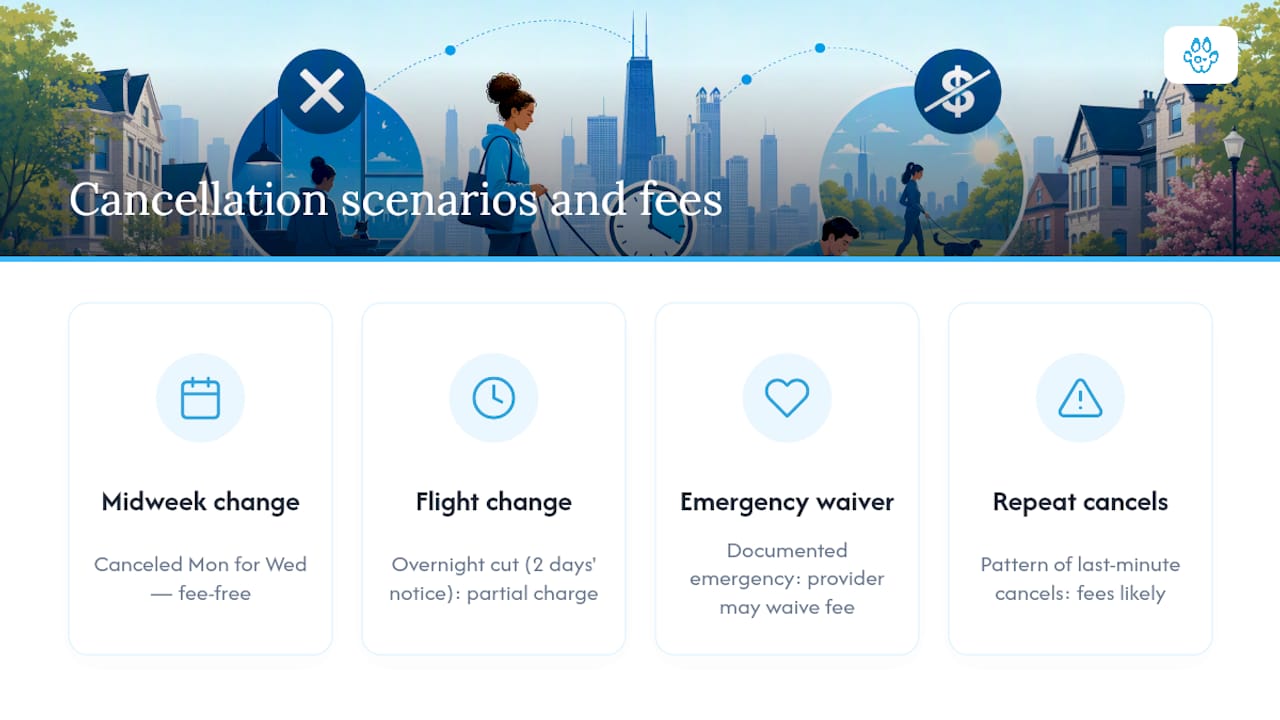
Scenario one: a canceled midweek walk. Your dog walker has a Wednesday afternoon visit booked, and you cancel Monday morning because you’re working from home that day. That’s well outside the short-notice window, so this is a fee-free change in almost every standard policy, Sparky Steps included.
Scenario two: a canceled overnight due to a flight change. You booked a four-night overnight stay for a trip, and your flight gets pushed up, cutting the trip short with two days’ notice. Because overnight bookings hold a slot that’s hard to refill on short notice, expect a partial charge for the days inside the short-notice window, even though the reason was completely out of your hands.
Scenario three: a genuine emergency. A family member is hospitalized and you need to cancel a booked visit with almost no notice. This is exactly the kind of situation where a provider’s discretion matters most, and a documented emergency is one of the more common reasons a fee gets waived for a client in good standing.
Scenario four: repeated last-minute cancellations. If a pattern develops where visits get canceled inside the short-notice window every few weeks, providers are far less likely to keep waiving fees, since the pattern itself starts to look like the real issue rather than a one-time hardship.
How Sparky Steps handles cancellations and where to book
If you’d rather work with a team that actually knows your dog’s name and your building’s buzzer code than gamble on whoever’s available on a gig app that night, that’s a common preference. Cancellation policies are often provided in writing at onboarding, with confirmation before every visit and real-time updates through DoTimely, including photos, GPS tracking, and visit notes, so there’s rarely any mystery about what happened while you were away.

When life throws a curveball, a flooded basement, a canceled flight, a genuine emergency, the care team looks at your history and the situation, not just a rigid chart of hours and percentages. Long-term clients with a clean track record generally get more flexibility than a brand-new booking canceled the night before.
If you want to see the full terms before you book, the pet sitting FAQ covers the most common cancellation and rescheduling questions in plain language. Ready to line up a trusted walker for your dog, cat, or small animal? Start with the pet sitting page to see coverage across the North Side and pricing that starts at $17 per visit, or check out home check-in services if your next trip just needs someone popping in to water the plants and check the mail. And if your other half is more the marathon-training type than the lap-cat type, the dog running services page might be exactly what your pup’s pent-up energy is asking for.
Sources
- How to Handle Pet Sitting Cancellations Professionally - TendPets Blog | TendPets
- Terms of Service - Doggie LatchKey Grand Rapids
- Service Agreement - Direct Pet Sitting
- Policies - Sit and Staycations - California
FAQ
What is a typical notice period for canceling a pet sitting visit?
Most providers want 24 to 72 hours’ notice for regular visits to avoid a partial fee, and 7 or more days for overnight or holiday bookings to avoid losing a deposit.
What fees can I expect for a last-minute pet sitting cancellation?
Same-day cancellations are frequently billed at the full visit price, while cancellations made 24 to 72 hours ahead often carry a partial charge around 50%.
Does Sparky Steps waive cancellation fees for emergencies?
Sparky Steps evaluates emergencies and severe weather case by case, and long-term clients with a documented emergency are generally given more flexibility than a first-time, last-minute cancellation.
How do I cancel or reschedule a Sparky Steps visit?
Cancellations and rescheduling requests go through a recorded channel like a portal or email so both you and your care team have a clear, time-stamped record of the change.
Are holiday pet sitting bookings refundable?
Holiday bookings usually carry stricter terms than regular visits, often requiring 14 to 31 days of notice and a non-refundable deposit, since that time is much harder to rebook.
Can I dispute a cancellation fee I think was charged incorrectly?
Yes. Reach out with your booking details as soon as you notice the discrepancy. Most providers will review the timeline and correct a genuine billing error or consider a goodwill credit.
Recommended
- Chicago Pet Care Checklist: Your Complete 2026 Guide
- How Weekend Pet Sitting Works: A Chicago Pet Owner’s Guide
- Guide to Hiring a Reliable Dog Walker in Chicago
- Dog Walker vs Doggy Daycare in Chicago: Which Fits Your Dog?
The Sparky Steps Team used AI to research and outline this article. A human on the team edited and fact-checked the final text.


