

A microchip cannot track your dog anywhere. It just holds an ID number that a scanner reads once someone finds your pet and brings them to a vet or shelter. A GPS tracker shows you live location on your phone, but only while it has power and a signal. The smartest move for most pet parents: microchip every pet as a permanent backup, then add a GPS tracker if your dog is an escape artist, roams off leash, or spends unsupervised time outside.
TL;DR:
- Microchips cannot track location and only provide an ID number when scanned, making registration and current contact info crucial for recovery.
- GPS trackers rely on cellular or satellite systems for real-time location but are subject to battery life, signal dead zones, and subscription costs.
- Layering a microchip with a GPS tracker offers the best chance for quick recovery, especially if the collar slips off or your dog is in a remote area.
- Selection should be based on your dog’s escape risk, environment, and size, prioritizing waterproof, lightweight, and reliable options.
- Maintaining updated registration for microchips and checking GPS device functionality regularly are vital steps in effective pet recovery.
Microchip Vs GPS Tracker: How Chips Actually Work
A pet microchip is a passive RFID device about the size of a grain of rice, typically implanted just under the skin between the shoulder blades. It carries no battery and does nothing on its own. Do microchips track location? According to the American Veterinary Medical Association, a microchip is not a GPS device and cannot track an animal’s whereabouts. It only broadcasts a unique ID number, and only when a scanner passes close enough to activate it.
Here’s the part that actually saves pets: when a good Samaritan brings a found dog to a shelter, a vet tech runs a universal scanner over the body. If the chip is registered, that ID number pulls up your name and phone number in a recovery database. That single step, scanning plus a current registry entry, is what reunites families. The American Kennel Club is blunt about it: the chip is worthless for recovery if the registration was never completed or the contact info is stale.
Where things go wrong isn’t usually the chip itself. It’s almost always paperwork:
- Unregistered chips. Some pet parents assume the vet automatically registers the chip. Many don’t. You have to do it.
- Outdated contact info. You moved, changed your number, or switched vets, and the registry still has your old apartment.
- Missed scans. Rare, but it happens if a shelter doesn’t scan the whole body. VCA Animal Hospitals notes that modern universal scanners read multiple frequencies now, which has cut down on missed chips considerably.
- Chip migration. Occasionally a chip shifts slightly under the skin, which is why trained scanning technique matters.
A microchip typically costs a moderate one-time fee at most vet clinics or shelter clinics, with no subscription, ever. If your dog isn’t chipped yet, we’ve written about why that first step matters so much before you even think about a tracker.
How GPS Trackers Actually Locate Your Dog
Here’s where people get confused, and honestly, it trips up a lot of smart pet parents: calculating a location and telling you about it are two completely different jobs. Gps explains that GPS satellites let a device figure out where it is on Earth. That part is free and works almost everywhere. But getting that location from the collar to your phone screen requires a second system entirely, usually a cellular connection, sometimes a satellite uplink, sometimes just Bluetooth.
That distinction explains why trackers come in three flavors, and picking the wrong one is the single most common mistake pet parents make:
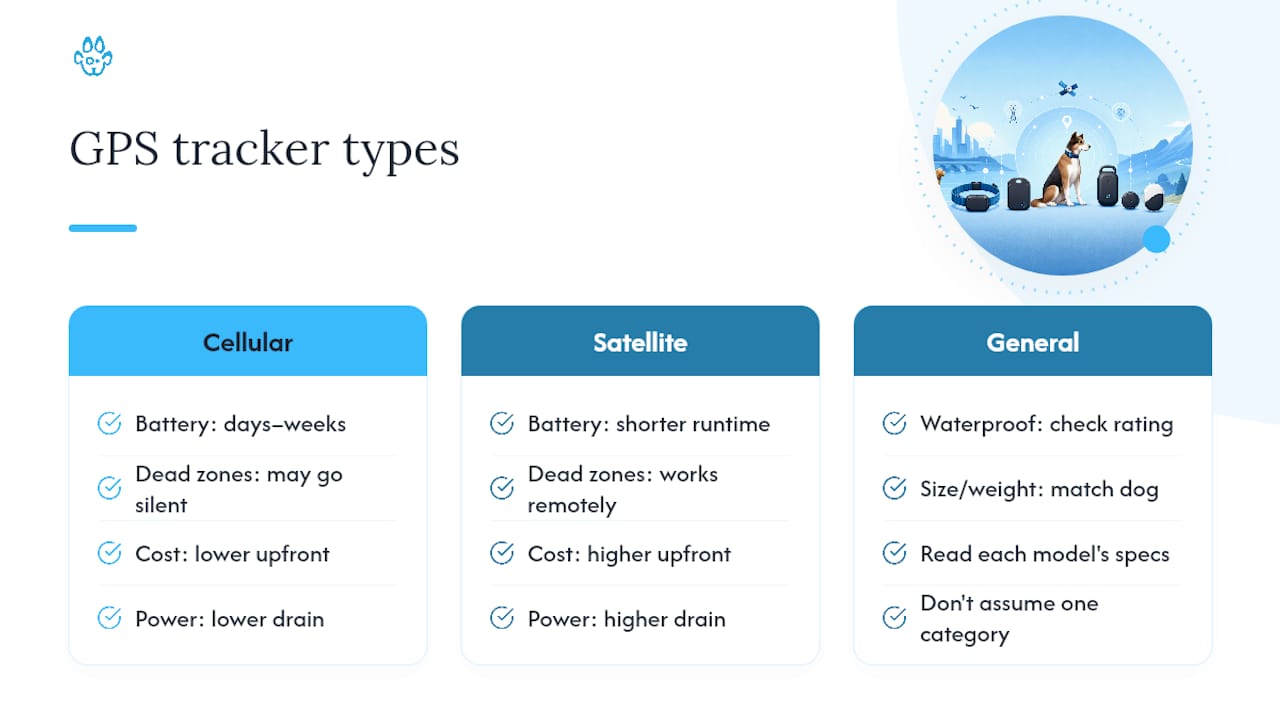
- Cellular trackers. Best for city and suburban dogs. They use phone networks to relay location, which means they work almost anywhere you’d typically walk a dog in Chicago, but they go dark in dead zones and usually carry a monthly subscription.
- Satellite-capable trackers. Built for rural or wilderness terrain where cell towers are sparse or nonexistent. They cost more and tend to drain batteries faster, but they work where cellular trackers simply quit.
- Bluetooth tags. Fine for finding your dog under the porch or three houses down. Useless once your dog is more than a couple hundred feet away.
Every GPS tracker shares the same weak points: batteries die (usually every few days to a couple weeks depending on the model), collars slip off during a chase, and a lapsed subscription turns a $150 collar into an expensive paperweight. Before you rely on one, run through this: charge it on a set schedule, actually open the app and confirm live tracking works (don’t just assume), keep phone notifications turned on, and check that the collar fits snugly enough that panic-induced wriggling won’t slip it off. Our guide to choosing a GPS tracker breaks down battery life and coverage by use case if you want a deeper dive.
Microchip Vs GPS Tracker: A Side-by-Side Comparison
| Method | Primary function | Maintenance | Works if collar comes off | Typical recovery timeframe | Typical cost model | Coverage limits |
|---|---|---|---|---|---|---|
| Microchip | Permanent identification | Register once, update contact info as needed | Yes, it’s under the skin | Hours to days, once scanned | One-time fee, no subscription | None; requires a scanner and physical handling |
| Cellular GPS tracker | Real-time location | Charge regularly, pay monthly subscription | No | Minutes to hours | Device cost plus monthly fee | Dead zones, weak signal indoors or underground |
| Satellite-ready tracker | Real-time location in remote areas | Charge frequently, higher subscription cost | No | Minutes to hours | Higher device cost plus subscription | Works almost anywhere outdoors, but battery drains faster |
| Bluetooth tag | Close-range location | Charge occasionally | No | Minutes, only if nearby | Lower one-time or low subscription cost | Roughly 100 to 300 feet range |
A few things jump out here. Microchips are the only method on this table that survives a lost collar, which is exactly the scenario where GPS trackers fail hardest. GPS trackers win on speed once your dog is out of sight, since a scanner can’t help you find a dog that’s still running. And Bluetooth tags are really a “dog slipped out the back door” tool, not a “dog is three neighborhoods away” tool. Layering a microchip with a cellular or satellite tracker covers both the immediate chase and the worst-case scenario where the collar doesn’t make it home.
How To Choose: A Risk-Based Decision Checklist
Not every dog needs the same setup, and that’s actually good news for your wallet. Start by being honest about your dog’s risk profile:
- Has your dog ever bolted, slipped a leash, or dug under a fence?
- Does your dog spend unsupervised time in a yard, even a fenced one?
- Do you live somewhere rural, or do most of your walks happen in dense city blocks?
- Is your dog small or lightweight, where a bulky tracker could be uncomfortable or even unsafe?
If you answered yes to any of the first two, a GPS tracker earns its keep. If you’re rural, lean toward a satellite-capable model since cellular coverage may vanish exactly when you need it most, a real-world failure point that trips up plenty of pet parents who assumed “GPS” meant “works everywhere.” If you’re mostly walking sidewalks in a dense neighborhood, a cellular tracker is plenty.
For cats and small dogs, weight and bulk matter more than people expect. Look for the lightest tracker that still meets your coverage needs, and check the waterproof rating unless your pet exclusively lounges indoors.
A few buying tips worth flagging before you swipe your card:
- Check battery life claims against real reviews, not just the marketing copy. Manufacturers tend to be optimistic.
- Confirm the subscription terms and cancellation policy before you commit.
- Look for a trial or return window in case the collar doesn’t fit right or the coverage disappoints in your neighborhood.
- Test the collar’s clasp under real conditions, not just standing in your kitchen.
And regardless of which tracker you land on, build a twice-yearly habit: confirm your microchip registry info is current, check that your GPS subscription hasn’t lapsed, and actually test live tracking before a big outing. Maintenance, not the technology itself, is where most lost-pet plans quietly fail.
What Consistent Care Teams Do Differently
Here’s something you learn fast once you’re walking the same 15 dogs every week: the technology only works if the humans around it have a routine. At Sparky Steps, our trained walkers check GPS-based visit updates before, during, and after every outing, not because we’re gadget people, but because it’s the fastest way to confirm a pet is safe and where they should be.
If a dog ever slipped a leash mid walk (rare, but we plan for it), the response is immediate: stop, secure other pets, retrace the route, and call the family right away, because minutes matter. Even then, a microchip stays the non-negotiable backstop. GPS tells you where a dog went. A registered chip is what brings them home if the trail goes cold. Since 2016, our founders have built that layered approach into a team that’s fully licensed, bonded, and insured, with real-time visit updates sent after every single visit.
Do Microchips And GPS Trackers Track Location The Same Way?
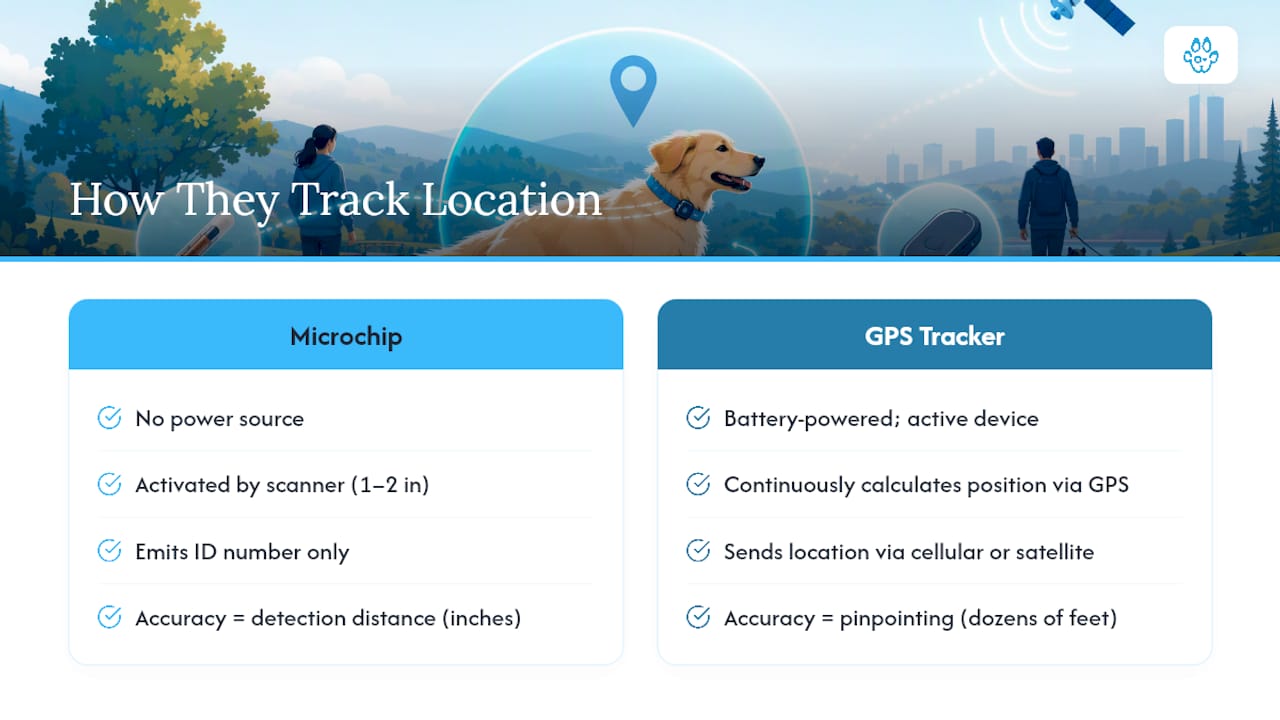
Not remotely. This is probably the biggest misunderstanding pet parents carry into a pet store, and it’s worth clearing up plainly: a microchip has no power source, no antenna reaching your phone, and no way to report location. It only activates within an inch or two of a scanner, at which point it spits out an ID number and nothing else.
A GPS tracker calculates its position continuously using satellite signals, then transmits that position to your phone through cellular data or a satellite uplink. That’s an active, ongoing process, which is exactly why it needs a battery and, usually, a subscription. The accuracy difference follows the same logic. A microchip’s “accuracy” is really about detection distance (an inch or two, tops) and correct registry matching. A GPS tracker’s accuracy is about how tightly it can pinpoint your dog on a map, often within a few dozen feet, though that number shifts depending on satellite visibility, tree cover, and whether you’re relying on cellular or satellite transmission.
People sometimes ask if a phone can detect a microchip the way it detects a Bluetooth tag. It can’t. Microchips use RFID frequencies that ordinary phones aren’t built to read, which is why you need a dedicated scanner, the kind every vet clinic and shelter keeps on hand. That’s also why a lost dog’s fastest path home almost always runs through a scanner and a clean registry entry, not a smartphone app.
Not All GPS Trackers Are Built The Same
Shopping for a GPS tracker feels a little like shopping for hiking boots. The category name tells you almost nothing about whether a specific pair will actually work for your trip. Battery life alone can swing from a couple of days to a couple of weeks depending on how often the device pings its location and whether it’s running on cellular or satellite transmission.
Waterproof ratings vary too, and this matters more than it sounds. A tracker rated for light rain is a different product than one built for a dog that swims in the lake every weekend. Size and weight matter just as much: a collar attachment built for a Labrador can look and feel absurd, or worse, unsafe, strapped onto a ten-pound terrier.
Reliability differences show up most in dead zones. Some cellular models fall back gracefully to a “last known location” feature that at least narrows your search. Others just go silent until signal returns, leaving you guessing. Satellite-capable models close that gap in remote areas but usually cost more upfront and burn through battery faster, since maintaining a satellite connection takes more power than talking to a nearby cell tower.
The honest takeaway: read the specific model’s real battery life, waterproof rating, and dead zone behavior before buying, rather than assuming “GPS tracker” is a single, interchangeable product category. It isn’t.
Is It Legal To Put A GPS Tracker On Your Own Pet?
Tracking your own dog or cat with a GPS collar is legal in the United States. There’s no federal or state law against monitoring a pet you own, and no permit required to buy or use one. The privacy questions that come up around GPS tracking almost always involve tracking other people, not pets, so you’re on solid ground here.
Where it gets slightly murkier is data handling. Some tracker brands collect location history and share it with third parties for advertising or analytics, buried in terms of service most people never read. If that bothers you, check the privacy policy before buying, particularly whether the company sells location data or keeps it only for your own app access.
One practical note: if your dog frequently roams onto a neighbor’s property or a shared space, a GPS tracker won’t create legal complications on its own, but local leash laws still apply regardless of whether your dog is chipped, tracked, both, or neither. The tracker tells you where your dog went. It doesn’t change your responsibilities once they get there.
A Note On Reducing Escape Risk In The First Place
Both microchips and GPS trackers solve the aftermath of an escape. The cheaper fix is preventing the escape altogether, and that’s really where supervision earns its keep. Sparky Steps is the alternative to leaving your dog alone for long stretches during the workday, when boredom, storms, or a loose gate latch turn into the moment your dog decides to explore the block.
Our walkers are the same trusted faces every time, not a rotating cast of strangers, and every visit comes with real-time updates through DoTimely, including GPS check-ins so you know your dog made it out and back safely. We’re licensed, bonded, and insured, and our founder holds Fear Free Certified Professional (FFCP) credentials alongside Pet Sitters International and NAPPS accreditations. Regular, supervised walks mean fewer chances for a dash out the door and a faster response if something ever does go sideways.
If your dog could use a consistent walker in their life (and honestly, whose dog couldn’t), take a look at Sparky Steps dog walking in Chicago, with visits starting at $17.
Where To Verify Your Pet’s Microchip Information
Before you rely on any recovery plan, confirm the basics are actually in place. The AVMA’s microchip FAQ, the AKC’s microchip explainer, VCA Animal Hospitals, GPS.gov, and the Humane Society all cover the fundamentals well. To check your own chip’s registration status, a lookup tool like petmicrochiplookup.org can confirm which registry holds your pet’s number.
Sources
- Microchipping: FAQs for pet owners | American Veterinary Medical Association
- How do dog microchips work? | American Kennel Club
- Microchipping your dog | VCA Animal Hospitals
- Gps
- How microchip can keep you and your pet together | Humane Society
FAQ
Can A Microchip Be Used As A Tracker?
No. A microchip has no battery or antenna capable of transmitting location, so it can’t function as a tracker in any sense. It only stores an ID number that a scanner reads once your pet is found, according to the AVMA.
Does A Microchip Show Location?
No, a microchip never shows location, live or otherwise. It’s a passive RFID chip that activates only within an inch or two of a scanner, revealing an ID number rather than GPS coordinates, as the American Kennel Club explains.
Can Your Phone Detect A Microchip?
No, standard smartphones can’t read pet microchips, since chips use RFID frequencies that phones aren’t equipped to scan. You need a dedicated universal scanner, the kind vet clinics and shelters keep on hand, per VCA Animal Hospitals.
Is There A Pet GPS Tracker Without A Monthly Fee?
Some Bluetooth-based tags skip monthly fees since they rely on your phone’s Bluetooth range instead of cellular data, but they only work at close range, typically a few hundred feet. Most true GPS trackers with real-time, long-distance tracking do require an ongoing subscription to cover cellular or satellite data costs.
Should I Get Both A Microchip And A GPS Tracker?
For most dogs with any escape risk, yes. A microchip serves as your pet’s permanent backup ID if a collar comes off, while a GPS tracker helps you find them minutes after they slip out, and Sparky Steps sees that layered approach work in real neighborhood situations regularly.
Recommended
- Why You Must Microchip Your Pet
- How to Choose a GPS Tracker for Your Dog
- Set Up Pet Care App Tracking: 2026 Guide
The Sparky Steps Team used AI to research and outline this article. A human on the team edited and fact-checked the final text.


