

The safest choice for a diabetic cat while you travel is either vet-clinic boarding or a trained, consistent in-home walker who confirms your cat has eaten before giving a single unit of insulin. The rule that overrides everything else: never inject a cat that hasn’t eaten. Before you leave, pack the supplies, walk your caregiver through a supervised practice run, and hand over a written plan with dosing times, your vet’s number, and signed consent to treat. Skip any of these steps and you’re gambling with a cat whose blood sugar doesn’t care that you’re on vacation.
TL;DR:
- For unstable or stressed cats, vet-clinic boarding or a caregiver with veterinary nurse experience offers the safest insulin management option.
- Caregivers must be thoroughly trained with supervised practice sessions, written plans, dummy syringes, and emergency contact details before oversight begins.
- Pack insulin properly by ensuring it stays cool but never frozen, and bring spares along with glucose rescue supplies and an emergency plan for time-zone shifts during travel.
- If a cat refuses to eat, caregivers must skip or reduce insulin doses according to vet approval, and immediately seek vet attention if signs of hypoglycemia occur.
- Consistent, trained in-home caregivers backed by reputable services reduce stress-related blood sugar fluctuations and facilitate close adherence to medical routines.
Who Should Give Your Cat Insulin While You’re Away?
Picking the right caregiver comes down to three questions: how stable is your cat’s blood sugar, how much medical backup might you need, and how well does your cat handle strangers in the house. Get honest answers to those, and the right option usually picks itself.
Vet-clinic boarding is the gold standard for cats who are newly diagnosed, prone to swings, or just plain finicky about eating. Staff can run a glucose check on the spot and escalate to treatment immediately if something looks off, which matters most for unstable or newly diagnosed cats. If your vet has boarding, or partners with a facility that does, this is worth the extra cost for peace of mind alone.
Catteries with a veterinary nurse on staff can be a solid middle ground, but only if you verify the credential yourself. “Vet experience” on a website sometimes means someone worked reception at a clinic for six months. Ask directly what their nurse’s training covers and whether they’ve handled diabetic cats before.
Trained, consistent in-home walkers tend to work best for cats who get stressed by unfamiliar spaces or other animals, which describes a lot of cats. A well-controlled, routine-loving cat often does better sleeping in their own bed and eating from their own bowl than adjusting to a new environment on top of managing blood sugar. The catch is that “trained” has to mean something real, not just a claim on a flyer.
A trusted friend or neighbor can work, but only with the same training and practice you’d expect from a professional. This is the lowest-cost option and also the highest-risk one if that person isn’t actually comfortable handling a syringe near your cat’s scruff.
Run through this before deciding:
- Has your cat’s glucose been stable over the last few checkups, or has your vet mentioned recent swings?
- Does your cat hide, hiss, or bolt around new people, or are they generally easygoing?
- Has the caregiver actually practiced drawing up and giving insulin, or just watched a video?
- How far is the nearest emergency vet from wherever your cat will be staying?
If you answer “unstable,” “stressed by strangers,” or “not sure” to any of the first two, lean toward clinic boarding. If your cat is steady and easygoing, a well-trained in-home walker is often the calmer, less disruptive route.
How Do You Train a Caregiver to Give Insulin Safely?
Handing someone a vial of insulin and a printed schedule is not preparation. Real preparation looks like this:
- Invite the caregiver over at least two or three times before you leave. Have them watch you feed, prep the syringe, and inject, so the routine stops feeling foreign.
- Let them draw up and inject while you watch, not the other way around. Correct their grip, their angle, and their timing in real time, while mistakes are still cheap.
- Require one full solo run with you present but hands off. If they hesitate, fumble the dose, or seem unsure about checking the insulin concentration, that’s information you need before you’re on a plane, not after.
- Write a single-page plan card. Include the insulin name and concentration, exact doses and times, the “feed first, then inject” rule in plain words, hypoglycemia rescue steps, your vet’s number, an emergency clinic number, and a signed consent to treat. AAHA’s client education guidance specifically recommends this kind of written sick-day plan, including guidance on reducing or skipping doses.
- Leave a dummy syringe filled with colored water at the exact fill line you use. This gives your caregiver a visual reference dose to check against, which catches a lot of “wait, is this right?” moments before they become a problem.
- Set up a simple log, even if it’s just a notebook by the food bowls. Time, amount fed, dose given or skipped. Instruct the caregiver to log immediately after each shot, not “later, when I remember.”
- Leave authorization and a way to pay for emergency care. A caregiver who has to hunt down your credit card number mid-crisis has already lost precious minutes.
Community-run resources like the Feline Diabetes Message Board echo this same pattern from owners who’ve actually done it: supervised practice, a dummy syringe, and a conservative plan for days when appetite drops. One useful anchor for the written instructions is a one-page pet sitter instruction template that keeps a caregiver from guessing.
How Should You Pack and Store Insulin for Travel?
Insulin is more fragile than most cat parents realize, and the biggest mistake isn’t heat. It’s freezing.
- Keep insulin cool but never let it freeze. A cool bag with an ice pack works fine as long as the pack never touches the vial directly. A folded towel between them solves this.
- Refrigerate insulin whenever you’re stationary, whether that’s a hotel mini fridge or your caregiver’s kitchen.
- Pack spares. Bring an extra vial or cartridge, syringes in the correct concentration (U-40 and U-100 are not interchangeable, so double-check before you buy replacements), pen needles if applicable, and backup meter or CGM supplies with fresh batteries.
- If your cat uses a suspension insulin, roll the vial gently between your palms to remix it. Never shake it. Shaking creates bubbles that throw off the dose.
- Follow the manufacturer’s in-use time limits once a vial is opened, and if a dose ever seems less effective than usual, don’t guess. Replace it and call your vet.
- Carry a glucose rescue source (honey or glucose gel) and your full glucometer or CGM kit everywhere the cat goes, even for a same-day trip to the vet.
Time-zone changes deserve their own thought. For short trips, many cats do fine staying on their home time zone rather than shifting the schedule. For longer trips across multiple zones, travel guidance for diabetic pets recommends keeping roughly 12-hour spacing between doses and shifting gradually with your vet’s input rather than jumping straight to local time. One caveat if your cat is on an oral medication like an SGLT2 inhibitor instead of insulin: those come with their own separate sick-day rules, so confirm with your vet which category your cat falls into before you finalize any travel plan.
What Should the Caregiver Do If Your Cat Won’t Eat?
This is the scenario every plan card needs to spell out in plain language, because hesitation here is genuinely dangerous.
The rule is simple: no food, no full dose. If your cat skips a meal or eats less than usual, the caregiver should either give a reduced dose your vet has pre-approved for exactly this situation, or skip the dose entirely and call you or your vet. Guessing is not an option. Insulin given to a cat with an empty stomach can send blood sugar crashing fast.
Hypoglycemia signs to watch for include:
- Lethargy or unusual weakness
- Trembling or wobbliness when walking
- Disorientation or seizures in severe cases
If any of these show up, the immediate move is to rub honey or glucose gel directly onto the gums and get to a vet right away, a protocol echoed across boarding and sick-day guidance for diabetic cats. Never try to force food or water into a cat who seems disoriented or unconscious.
Other red flags that warrant same-day vet care, even without full hypoglycemia: ongoing vomiting, sudden collapse, or breathing that seems labored or has an unusual sweet smell. And whatever happens, the caregiver should log it immediately: time, whether the dose was given or skipped, how much food was eaten, and a glucose reading if a meter or CGM is available. That log is the first thing your vet will ask about.
What Goes On Your Departure-Day Checklist?
The morning you leave is not the time to discover you’re missing syringes. Run through this list the night before, then confirm again before you walk out the door:
- Insulin vials or cartridges, packed with spares
- Syringes or pens in the correct concentration, plus extra needles
- Glucometer or CGM with fresh batteries and enough test supplies
- Glucose or honey for hypoglycemia rescue
- Your cat’s exact diet, portioned out, plus their regular food bowls
- The dummy syringe with the reference dose
- The written plan card, taped somewhere visible like the fridge
- Confirmed visit times and a working method for the caregiver to log each shot
- One last supervised trial run on departure morning, if you have time for it
- Calming bedding, a worn piece of your clothing for scent, and a couple of familiar toys
- Signed consent to treat and your vet’s and emergency clinic’s contact numbers
If your cat is boarding rather than staying home, double check that the facility itself has reviewed your plan card and knows the won’t-eat protocol before you hand over the carrier.
Why Consistency in Care Reduces Risk
A rotating cast of unfamiliar people is one of the fastest ways to turn a stable diabetic cat into a stressed one, and stress alone can throw off blood sugar. Sparky Steps built its whole model around the opposite idea: the same trusted walkers every time, so your cat is never re-learning a stranger’s hands and voice on top of managing insulin.
Every Sparky Steps walker is backed by a team that’s licensed, bonded, and insured, and The founder holds credentials emphasizing calm, low-stress handling. Real-time visit updates mean you get photos and notes after every visit, not radio silence until you land.
In practice, that means supervised practice runs before departure, strict adherence to your vet’s feed-first and sick-day rules, and immediate escalation if something looks wrong, backed by another walker in case your primary caregiver ever needs relief. Whatever caregiver you ultimately choose, hold them to this same bar: trained, consistent, and honest about what they don’t know.

Ready to Book a Trusted In-Home Caregiver?
If the checklist above has you leaning toward in-home care over boarding, Sparky Steps offers exactly that kind of consistency for cat parents on Chicago’s North Side. Cat sitting visits come from the same trusted walkers every time, not a rotating pool of strangers, so your diabetic cat gets a familiar face and a familiar routine instead of one more variable to manage while you’re gone.
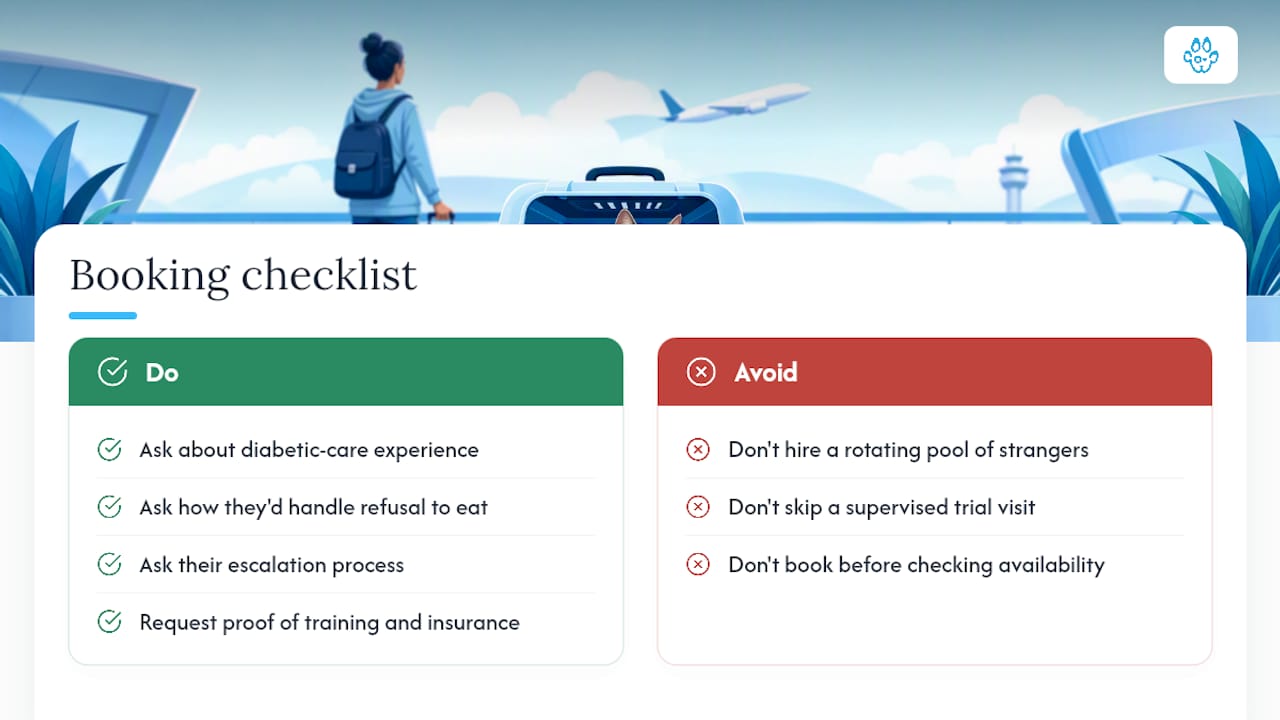
On your first call, ask directly: has this walker cared for a diabetic cat before, how do they handle a cat that refuses to eat, what’s their escalation process if something seems off, and can they show proof of their training and insurance. A reputable service will answer all four without hesitation. Sparky Steps also offers home check-ins if your cat only needs a shorter visit, and can arrange a supervised trial visit before your trip so you can watch a walker prep and give a dose yourself, the same practice run this article recommends for any caregiver. Reach out through the cat sitting page to check availability and set up that trial before you book your travel.
Sources
This guide draws on the AAHA diabetes management guidelines, VCA Hospitals’ insulin treatment guidance, boarding-versus-home-care comparisons from PawSpot, and travel-specific advice from PetsLikeMine. For readers vetting boarding facilities directly, Animal Booking’s pet boarding resources are also worth a look.
This article is general information, not a substitute for advice from a qualified doctor. Consult a qualified healthcare professional about your own circumstances before acting on anything here.
- 2026 AAHA diabetes management guidelines for cats — section 11: client education
- Boarding a diabetic cat in NZ: Insulin, timing & where to board (2026) | PawSpot
- Travel, Boarding and Sick-Day Rules for a Diabetic Pet | PetsLikeMine
FAQ
Can a cat go a few days without insulin?
Skipping insulin for a day or two rarely causes an immediate crisis in most stable diabetic cats, but it’s never a plan worth making on purpose. Blood sugar can climb into dangerous territory faster than owners expect, so any skipped dose should be a deliberate, vet-approved decision tied to poor appetite, not a scheduling convenience.
How long can a cat miss an insulin injection?
There’s no safe universal window, since it depends on the individual cat’s stability and how long they went without food. If a dose gets missed or skipped because the cat wouldn’t eat, contact your vet the same day rather than waiting to see what happens.
Does cat insulin have to be exactly 12 hours apart?
Most cats do best on a consistent schedule roughly 12 hours apart, since insulin is typically paired with meals on a twice-daily routine. A little flexibility is generally fine, but big swings in timing should be discussed with your vet rather than improvised.
Should I give my cat his insulin if he hasn’t eaten?
No. The rule every caregiver needs memorized is feed first, then inject, and if the cat won’t eat, you either give a reduced dose your vet has pre-approved for that exact situation or skip the dose and call your vet. Giving a full dose on an empty stomach risks a dangerous drop in blood sugar.
Recommended
- Pet Parents: One Page Pet Sitter Instructions to Stop Sitters Guessing
- Chicago Pet Care Checklist: Your Complete 2026 Guide
- 5 Steps to Travel Smoothly With Your Pet
The Sparky Steps Team used AI to research and outline this article. A human on the team edited and fact-checked the final text.


