

The best rainy day dog exercise combines short bursts of active movement with mental work like scent games, then closes with a long-lasting chew to help your dog settle. Aim for 20 to 60 minutes total, broken into rounds rather than one long session. Skip straight to active play without a mental cooldown, and you’ll end up with a wired dog bouncing off your couch cushions at 9 PM. The activities below give you the full toolkit.
TL;DR:
- Combining short bursts of active play with mental tasks like scent games and puzzle feeders ensures dogs burn energy and stay mentally engaged without overstimulating them.
- Sequencing activities into active, mental, and settle phases prevents dogs from becoming overly aroused and helps them relax after exercise.
- Food-based enrichment tools such as puzzle feeders, treat hides, and long-lasting chews outperform toys in maintaining engagement and reducing stress.
- Setting up a safe indoor play area with traction rugs and removing hazards minimizes injury risks and accommodates noise-sensitive dogs.
- Professional dog walking and sitting services offer essential outdoor exercise and socialization when rainy weather prevents outdoor walks.
Rainy Day Dog Activities That Actually Tire Them Out
Not every indoor game earns a spot on this list. These are the ones that combine physical output with the kind of mental work that actually leaves a dog satisfied, not just wound up.
- Hallway fetch. A carpeted hallway is basically a bowling lane for energy. Use a soft toy (never anything hard that could bounce into a wall or a shin), and set clear boundaries by closing doors at each end so the game stays contained.
- Tug with rules. Tug is not a free-for-all. Teach a solid “take it” and “drop it,” and pause the second teeth touch skin. This game builds impulse control right alongside the workout.
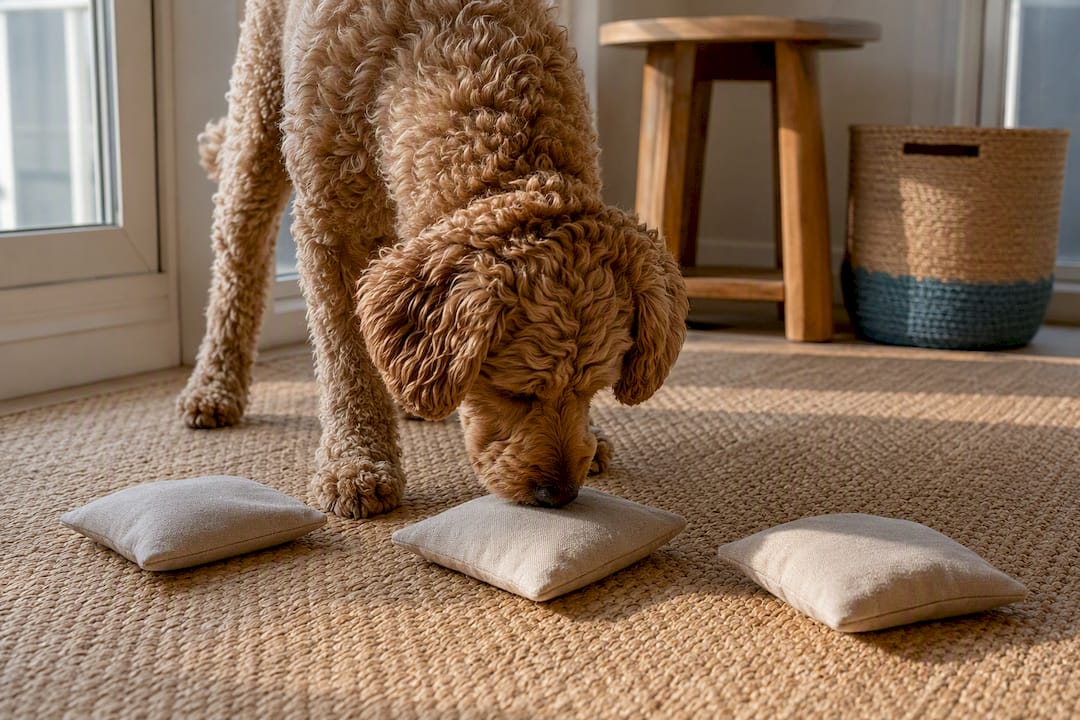
- Nosework and “find it.” Hide a few treats around one room and release your dog to hunt. A snuffle mat, where treats hide in fabric strips, turns this into a slower, sniff-heavy version that burns mental energy fast.
- Puzzle feeders. Any dispensing toy that makes your dog work for kibble slows down mealtime and doubles as a brain workout. Rotate two or three styles so the challenge stays fresh.
- Long-lasting chews. A supervised chew session after activity is one of the most reliable ways to bring your dog’s energy back down.
- Five-minute training bursts. Short, focused shaping sessions (teaching “spin,” “touch,” or a new trick) tap out mental energy faster than most owners expect.
- DIY obstacle course. Couch cushions to climb over, a broom laid flat to step across, a low ottoman to weave around. Keep it low-impact, especially on hardwood.
- Stair work. A few controlled up-and-down reps burns energy in small square footage, but skip this one entirely for puppies with growing joints or seniors with arthritis.
- Hide-and-seek. Have your dog “stay,” walk to another room, and call them to find you. It builds recall and burns nervous energy at the same time.
- The shell game. Hide a treat under one of three cups and let your dog pick. It is a deceptively good impulse-control exercise.
- Supervised indoor play dates. If you have a calm, compatible dog friend nearby, a controlled indoor play session covers social and physical needs in one shot.
- Rotate everything. Never run the same three games every rainy afternoon. Dogs, like kids stuck inside during a storm, get bored of the same toy box fast.
The common mistake is running through this list in one straight shot: fetch into tug into an obstacle course, all high energy, no cooldown. That pattern doesn’t tire a dog out. It revs them up.
How to Sequence a Rainy Day Routine That Settles Your Dog
The order you run these activities in matters more than how many you pack in. Here’s the structure that behavior-aware trainers use to burn energy without spiking arousal:
- Active phase (5 to 10 minutes). Fetch, tug, or a quick obstacle course to burn the initial burst of pent-up energy.
- Mental phase (3 to 5 minutes). Shift straight into scent work, a puzzle feeder, or a training burst. This drops arousal while keeping the brain engaged.
- Settle phase (5-plus minutes). Hand over a long-lasting chew and let your dog work on it somewhere calm, like a mat or crate.
Repeat that three-part cycle two to four times across the day rather than trying to cram all the exercise into one marathon session. For most adult dogs, 20 to 60 minutes of total activity spread across the day covers the exercise gap that a canceled walk leaves behind.
Adjust for who is actually on the other end of the leash. Puppies need shorter active phases (think 2 to 3 minutes) with more frequent settle breaks, since their joints and attention span both tap out fast. Senior dogs benefit from swapping stairs and jumping games for nosework and puzzle feeders almost entirely. High-drive breeds, like working and herding dogs, often need an extra mental phase layered in before they’ll settle for the chew.
Watch for the warning signs that a dog has tipped from “exercised” into “overstimulated”: hard staring, jumping and mouthing, zoomies that don’t taper off, or ignoring cues they normally know cold. If you see it, skip straight to the settle phase, even if you had more planned.
Pro Tip: If your dog seems more amped up after play than before it, you probably need more mental phases and fewer active ones. Scent work tires a dog out in a way that looks nothing like exhaustion; it just looks like a dog who finally stops asking for more.
Which Toys Actually Work? What the Research Says
Not all enrichment toys deliver equal payoff, and the research on this is more specific than most pet blogs let on. A 2022 study on companion dogs found that food-based enrichment and interactive play significantly increased relaxed behaviors and reduced stress and alert behaviors in dogs, with results strong enough to rule out chance.
Chews outperform toys here, and by a wide margin. A cross-over study comparing enrichment types found long-lasting chews produced the most total engagement time, lasting several minutes on average, and lower arousal than food-dispensing toys or smart dispensers. Separate accelerometry research backs this up from a different angle: food enrichment produced more active, locomotive behavior and longer engagement than scent-only or texture-only enrichment.
The practical takeaway: lean on food-based options. That means:
- Puzzle feeders for meals, not just treats
- Snuffle mats for slower, sniff-driven engagement
- Long-lasting chews sized appropriately for your dog’s jaw strength
Check any toy for wear before every use, and rotate your lineup every week or two so nothing goes stale. A durable puzzle toy from a trusted pet retailer is worth the investment over a flimsy dollar-bin version that falls apart after two sessions.
Setting Up a Safe Indoor Play Zone
A slick hardwood floor turns fetch into a liability fast. A few basics keep rainy day play safe for your dog and your décor:
- Lay down rugs or runners in the play zone to give paws real traction.
- Clear breakables, cords, and small chewable objects from the area before you start.
- Stick to one designated play zone so your dog learns where the “game” happens.
- Watch chews closely and pull them the moment a piece breaks off small enough to swallow.
- Skip high-impact games entirely if your dog has storm phobia or noise anxiety. In that case, replace active play with low-arousal enrichment like a chew or a slow-scatter feeding session, and consider talking to a trainer or your vet if the anxiety seems severe.
When You Need a Professional on Rainy Days
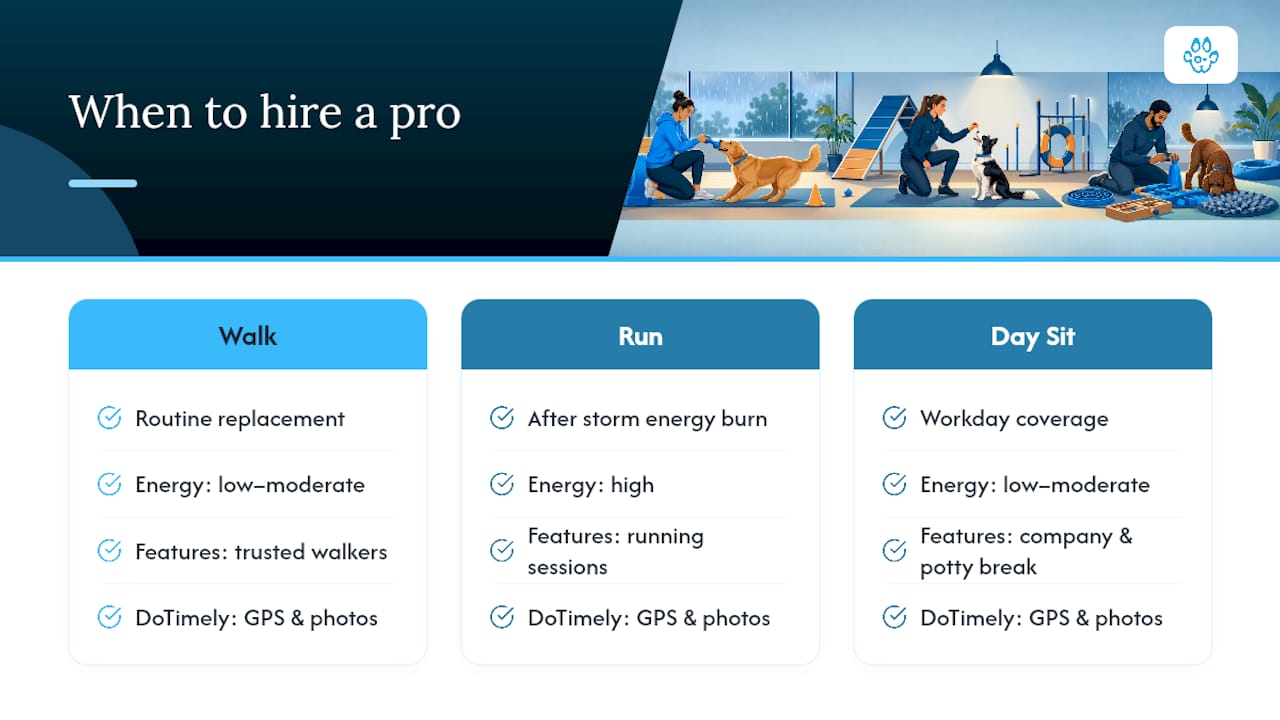
Some days, no amount of hallway fetch replaces a real walk. That’s where Sparky Steps comes in as a direct option, not just a backup plan. When Chicago weather cancels your dog’s usual outdoor time, our dog walking services keep the routine intact with the same trusted walkers your dog already knows, rain gear and all.
For dogs who need to burn serious energy once a storm clears, we also offer dog running sessions built for higher-drive pups who need more than a living room obstacle course. And if you’re stuck at work during an all-day downpour, a daytime dog sitting visit gives your dog company, enrichment, and a bathroom break without you racing home at lunch.
Every visit comes with real-time updates through DoTimely, so you get GPS tracking, photos, and notes the moment your walker leaves. The team includes professionals trained in positive reinforcement and fear-free handling methods, with appropriate insurance coverage. Check availability in your North Side neighborhood and book a visit through the dog walking page before the next forecast turns gray.
Sources
For readers who want the full research behind these recommendations: the 2022 companion dog enrichment study, the 2023 cross-over study on food-based enrichment, and the 2025 accelerometry research on enrichment types all informed the toy and engagement guidance above. For more indoor activity ideas, see Sparky Steps’s guide on rainy day activities for you and your dog.
- Animals, 2022: Effects of environmental enrichment on companion dogs
FAQ
What is the 3-3-3 rule for dogs?
The 3-3-3 rule is a general guideline for newly adopted dogs, describing rough timelines for adjustment: 3 days to decompress, 3 weeks to learn a routine, and 3 months to feel fully at home. It is not a rainy day exercise framework, but it explains why a newly adopted dog might need gentler, shorter indoor sessions while they settle in.
What is the 7-7-7 rule for dogs?
Definitions of the 7-7-7 rule vary depending on the source, and there is no single agreed-upon version. If you’ve seen it referenced for socialization or puppy exposure, treat it as informal guidance rather than a clinical standard, and focus instead on the activity rotation covered above for rainy day sessions.
What should I do on a rainy day with my dog?
Rotate short active play, like fetch or tug, with mental work like puzzle feeders or nosework, then finish with a long-lasting chew to help your dog settle. Spread 20 to 60 minutes of total activity across several short rounds rather than one long session. If your dog still seems restless, a professional dog walking visit can cover the outdoor time indoor games can’t replace.
How do you tell a dog “no” without saying the word?
Dogs read body language and tone more than specific words, so a firm, low “eh-eh” sound paired with redirecting to an acceptable behavior often works better than repeating “no.” Consistency matters more than the exact word you choose. Pairing a verbal marker with a physical cue, like turning your body away, reinforces the message clearly.
Recommended
- Five Rainy Day Activities For You and Your Dog
- Stormy Day Dog Training Games
- Winter Exercise Tips: Indoor Activities for Dogs
- Mental Exercise for Dogs: Beyond Physical Activity
The Sparky Steps Team used AI to research and outline this article. A human on the team edited and fact-checked the final text.


