

Dog walking frequency is defined as the number of daily walks a dog needs to maintain physical health, mental balance, and appropriate behavior. Most healthy adult dogs need 2–4 walks per day totaling 30–60 minutes of exercise, though breed energy, age, and your urban environment all shift that number. For Chicago pet parents navigating apartment hallways, icy sidewalks, and packed North Side schedules, getting this right matters more than most guides let on. The 3-Factor Walk Formula, which weighs Age, Breed Energy, and Environment, is the clearest framework for personalizing your dog’s daily routine.
Dog walking frequency explained: what the baseline really means
The 2–4 walks per day guideline is a starting point, not a finish line. It covers the average adult dog living a moderately active life. What it does not cover is the wide range of needs across breed types, life stages, and city-specific conditions.
Walking delivers two distinct benefits: physical exercise and mental stimulation. A dog that only gets physical movement without mental engagement is like a kid who runs laps but never gets recess. The body gets tired, but the brain stays restless. Behavioral signs of under-exercise include unexplained weight gain, destructive behavior, excessive barking, and restlessness. Those signs tell you the current schedule is not working.
Consistency matters more than volume. Sporadic long walks on weekends do not substitute for a daily routine. Inconsistent walking increases injury risk and behavioral stress in dogs. Think of it like your own workout habit: one four-hour hike on Saturday does not replace five short walks spread across the week.
How to determine the right walking frequency for puppies in the city
Puppies follow a simple rule that most new pet parents have never heard: 5 minutes of structured walking per month of age, twice daily. A 4-month-old puppy needs roughly 20 minutes of exercise twice per day. That is it. No marathon strolls through Lincoln Park, no matter how much energy they seem to have.
Over-exercising a puppy damages developing joints and growth plates. Chicago’s concrete sidewalks are especially hard on young bones. Short, frequent outings protect your pup while still giving them the socialization and potty breaks city life demands.
Urban puppy walks serve multiple purposes at once:
- Potty training: Puppies need to go out every 2–3 hours, so frequency is high even when duration is short.
- Socialization: Exposure to buses, bikes, strangers, and other dogs builds confidence early.
- Mental enrichment: Let them sniff everything. A 10-minute sniff-fest tires a puppy faster than a brisk 20-minute walk.
- Safety: Avoid busy intersections and salt-treated sidewalks in winter. Paw wax or booties protect tender paws.
Chicago winters add a real complication for puppy pet parents. Sidewalk salt is toxic if licked, and cold pavement can cause frostbite on small paws in under 15 minutes. Keep winter puppy walks short and always wipe paws when you get back inside.
Pro Tip: Let your puppy lead the sniff during at least one walk per day. Nose-led walks provide mental exhaustion that shortens the “zoomies” window considerably. Your furniture will thank you.
What is the ideal walking schedule for adult dogs by breed energy?
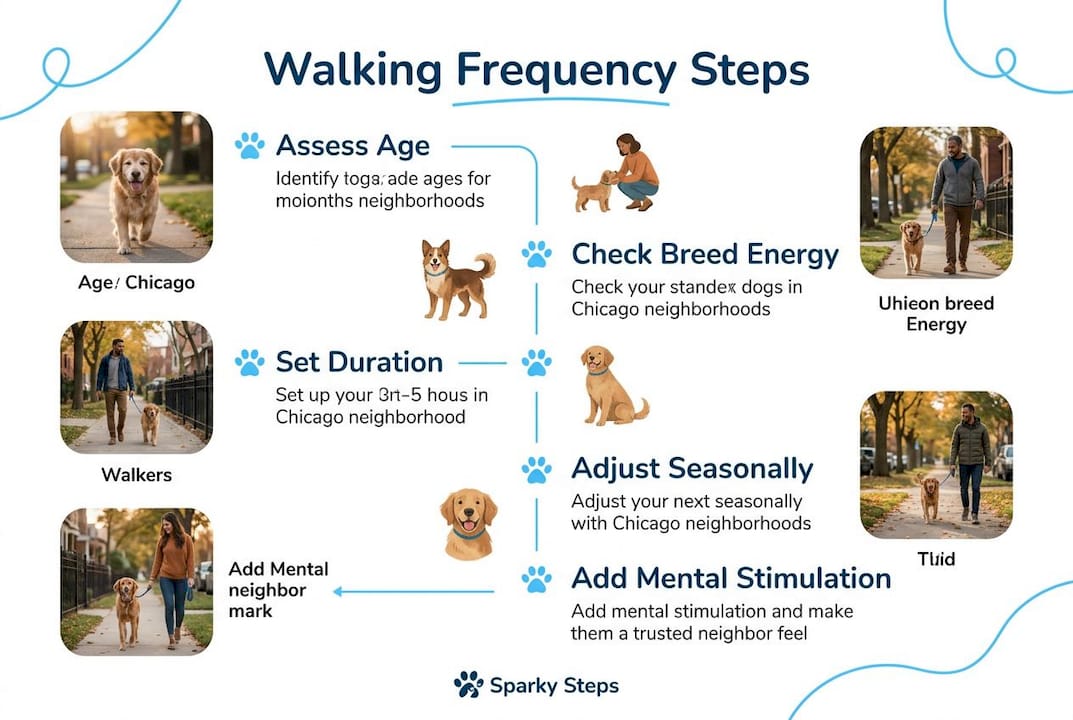
Adult dogs fall into three broad energy categories, and each one calls for a different daily walking schedule. The 3-Factor Walk Formula, which combines Age, Breed Energy, and Environment, gives you the clearest picture of what your specific dog actually needs.
| Breed energy level | Example breeds | Daily walks | Total daily duration | Pace |
|---|---|---|---|---|
| High energy | Border Collie, Husky, Vizsla | 3–4 walks | 90–120 minutes | Brisk to running |
| Medium energy | Labrador, Golden Retriever, Beagle | 2–3 walks | 45–60 minutes | Moderate |
| Low energy | Bulldog, Pug, Basset Hound | 2 walks | 20–30 minutes | Leisurely |
High-energy working and herding breeds need 90–120+ minutes of daily exercise. That is a serious time commitment for a Chicago pet parent with a full-time job and a third-floor walkup. Toy and small breeds often thrive on 30–45 minutes total per day, which is far more manageable.
A few practical points for urban adult dog walking:
- Split walks across morning, midday, and evening to prevent long gaps between outings.
- A midday walk is the most commonly skipped, and it is often the most needed. Dogs left alone for 8+ hours without a midday break show higher rates of anxiety behaviors.
- High-energy dogs in small apartments need structured exercise, not just a quick trip to the corner and back.
Pro Tip: If your high-energy dog still seems wired after a 60-minute walk, add 10 minutes of leash training or a short sniff game rather than extending the walk. Mental work burns energy faster than distance.
For dogs that are overweight or returning from inactivity, Texas A&M VMC recommends starting with 5–10 minute walks and increasing duration by 5 minutes weekly. Gradual progression prevents injury and builds sustainable fitness.
How should you adjust walks as your dog gets older?
Senior dogs need a different approach entirely. Older dogs benefit from shorter, more frequent walks rather than one long daily outing. Three to four walks of 10–15 minutes each keeps joints moving without causing pain or exhaustion.
The signs of over-exercise in senior dogs are worth knowing by heart:
- Excessive panting that continues long after the walk ends
- Limping or favoring one leg during or after exercise
- Reluctance to stand up or start the next walk
- Stiffness the morning after a longer outing
Recognizing these signs early allows you to adapt the schedule before an injury sets in. If your senior dog shows any of these signals, shorten the next walk and give them a rest day.
Chicago’s terrain creates specific challenges for aging dogs. Uneven brick sidewalks, curb drops, and icy patches in winter all increase fall risk for dogs with arthritis or hip dysplasia. Choosing low-impact routes, flat surfaces, and grassy paths in parks like Winnemac or River Park makes a real difference. Sparky Steps walkers who work with senior dogs know these routes well. For a deeper look at walking dogs with arthritis safely, Sparky Steps has a full guide built around Chicago’s specific conditions.
Pro Tip: Swap one walk per week for a slow, nose-led sniff session in a grassy area. Senior dogs get tremendous mental benefit from sniffing without the physical strain of a brisk pace.
Why does mental stimulation during walks matter so much?
Physical distance is only half the story. Sniffing activates dogs’ natural scent-tracking and turns a walk into profound mental exercise. A 20-minute sniff walk can tire a dog more effectively than a 40-minute power walk on a fixed route.
This matters especially for Chicago dogs living in apartments. They do not have a yard to roam and explore. Every walk is their entire outdoor world for the day. Making those walks mentally rich is not a luxury. It is a necessity.
Ways to add mental enrichment to your daily dog walking routine:
- Nose-led walks: Let your dog choose the direction and pace for at least part of the walk. Follow their nose.
- New routes: Rotate between three or four regular paths. New smells and environments keep the brain engaged.
- Brief training stops: Ask for a sit, a down, or a heel at random points. Five seconds of focus work adds up.
- Sniff spots: Identify two or three “sniff zones” on your regular route where your dog gets unlimited time to investigate.
Mental stimulation through scent work significantly reduces destructive behaviors and canine anxiety. A dog that gets to use its nose comes home calmer and more settled than one that just walked in a straight line. For more ideas on keeping your dog mentally engaged, Sparky Steps covers mental exercise beyond physical activity in detail.
Pro Tip: Bring a small handful of kibble on walks and scatter it in a grassy patch. Watching your dog hunt for pieces is genuinely entertaining, and it counts as enrichment. Win-win.
Managing walk frequency through Chicago’s seasons
Chicago does not make dog walking easy year-round. Urban environmental factors like weather and safe route availability directly affect how often and how long you can walk your dog. Adapting your schedule seasonally keeps your dog safe and your routine intact.
Seasonal adjustments that actually work:
- Summer heat: Walk before 8:00 AM or after 7:00 PM to avoid hot pavement. Asphalt can reach temperatures that burn paw pads on a 90-degree Chicago afternoon.
- Winter cold: Limit walks to 15–20 minutes for small or short-coated dogs when temperatures drop below 20°F. Use booties or paw wax to protect against salt and ice.
- Rain and mud: Shorter walks are fine. A wet dog that gets a good towel-down and a puzzle toy indoors is a happy dog.
- Extreme cold or heat: Substitute outdoor walks with indoor enrichment, stair climbing in your building, or a quick training session in the hallway.
Chicago pet parents who set up a cozy outdoor pet corner on a porch or balcony give their dogs a safe outdoor space during weather that makes full walks impractical. Even 10 minutes of fresh air and outdoor smells counts as enrichment on a rough weather day.
Key Takeaways
The most effective dog walking schedule combines consistent daily frequency, age-appropriate duration, and mental enrichment on every outing.
| Point | Details |
|---|---|
| Baseline frequency | Most adult dogs need 2–4 walks per day totaling 30–60 minutes of exercise. |
| Puppy rule | Follow the 5-minute-per-month-of-age rule, twice daily, to protect growing joints. |
| Senior adjustment | Shift to 3–4 short walks of 10–15 minutes each as dogs age to protect joint health. |
| Mental enrichment | Allow sniffing on every walk. It tires dogs faster and reduces destructive behavior. |
| Consistency wins | Daily routine outperforms sporadic long walks for both physical health and behavior. |
What 10 years of Chicago dog walking taught me about frequency
I have watched a lot of pet parents get this wrong in the same direction: they do too much on weekends and too little on weekdays. They think a two-hour Saturday walk in Montrose Beach makes up for three days of rushed five-minute outings. It does not. Dogs are creatures of routine in a way that most people underestimate.
The other thing I see constantly is pet parents optimizing for distance when they should be optimizing for engagement. A dog that walks two miles staring at the same block of Ravenswood storefronts every day is bored. A dog that spends 25 minutes sniffing a single patch of grass in North Center is genuinely enriched. The nose is the whole point.
Chicago specifically throws curveballs that no generic guide accounts for. The polar vortex is real. The summer heat index is real. A dog walking schedule that works in october falls apart in january if you have not planned for it. I always tell pet parents: build your winter routine in september, before you need it. That way it is already a habit when the first freeze hits.
The most consistent thing I have noticed over 10 years is that the dogs doing best are not the ones with the longest walks. They are the ones with the most predictable ones. Same walkers, same times, same general routes with enough variation to keep things interesting. That predictability is what Sparky Steps is built around, and it is what I am most proud of.
— Michael Jaurigue
Sparky Steps is here when your schedule gets in the way
Life in Chicago moves fast. Work runs long, the weather turns, and suddenly your dog has been inside for six hours. Sparky Steps has been helping North Side pet parents fill those gaps since 2016, with the same trusted walkers showing up every time, not a different stranger each visit.
For high-energy dogs that need more than a standard walk, Sparky Steps offers Chicago dog running services designed to give your fur baby a real workout. For pet parents who travel or work long hours, pet sitting in Chicago keeps your dog on their routine even when you cannot be there. Every visit includes real-time updates via DoTimely: GPS tracking, photos, and visit notes sent straight to you. Licensed, bonded, and insured. Always. ❤️
FAQ
How many times a day should I walk my dog?
Most healthy adult dogs need 2–4 walks per day. The exact number depends on breed energy level, age, and how long each walk lasts.
What is the 5-minute rule for puppies?
The 5-minute rule means no more than 5 minutes of structured walking per month of age, twice daily. A 3-month-old puppy should walk no more than 15 minutes per session.
How long should I walk my senior dog?
Senior dogs do best with 3–4 short walks of 10–15 minutes each rather than one long outing. Shorter, more frequent walks protect joints and prevent exhaustion.
Does sniffing count as exercise for dogs?
Yes. Sniffing activates a dog’s scent-tracking instincts and provides significant mental stimulation. A nose-led walk often tires a dog more effectively than a longer walk at a fixed pace.
How do I adjust my dog’s walking schedule in Chicago winters?
Limit walks to 15–20 minutes for small or short-coated dogs when temperatures fall below 20°F. Use paw wax or booties to protect against sidewalk salt, and substitute indoor enrichment activities on extreme weather days.
Written by the Sparky Steps Team.
Authorship Note
The content above aligns with the values of Sparky Steps LLC. While our trusty artificial intelligence helped organize the article, whip up some fun images, and translate ideas into clear, practical language, the final masterpiece is a delightful collaboration between passionate human writers who adore animals and a sprinkle of artificial intelligence magic. Remember, if you think writing is easy, try typing with paws!


