


Trusting someone with your dog and a key to your home is a real leap, and it should be. Building that trust with a regular dog walker takes more than a friendly first impression. It comes from clear communication, thorough vetting, and consistent routines your dog can count on every single week. Chicago pet parents face specific challenges here: dense urban neighborhoods, local leash laws, and the temptation to hire whoever shows up cheapest on an app. This guide covers the practical steps, from the first meet-and-greet to ongoing communication habits, that make trusting a dog walker feel earned rather than like a gamble.
How to build trust with a regular dog walker from day one
The foundation of any strong walker relationship is the meet-and-greet. This first in-person session is where trust either starts or stalls. MSPCA-Angell recommends using this meeting to share your dog's minor quirks, dangerous behaviors, medication needs, and home security instructions. That level of detail removes uncertainty for the walker before their very first solo visit.
Come prepared. Bring your dog, a written summary of their medical history, your vet's contact information, and a backup emergency contact. If your dog has a trigger (skateboards, other dogs, loud trucks on Milwaukee Avenue), say so clearly and in writing. A walker who learns about a trigger for the first time mid-walk is a walker who is already behind.

Watch how the candidate interacts with your dog during the meeting. Do they crouch down to the dog's level? Do they let the dog approach on its own terms? A walker who respects a dog's body language during a calm introduction will respect it on a busy Chicago sidewalk too.
One practical step worth taking: prepare a one-page dog profile before the meet-and-greet. Include your dog's name, age, weight, breed, triggers, medications, vet info, and two emergency contacts. Hand it to every candidate. The ones who read it carefully are the ones worth keeping.
Use the meet-and-greet to cover logistics too: which door they will use, where the leash hangs, how to arm the alarm, and what to do if your dog refuses to go outside. These details sound small. They prevent big problems. For more on preparing your dog for new people in their routine, the dog walker meet-and-greet guide from Sparky Steps walks through the full process step by step.
What does a reliable dog walker vetting process look like?
Finding a reliable dog walker means going well beyond a five-star rating on a review site. IBPSA warns that online reviews are incomplete indicators of trustworthiness. A professional background check, documented safety policies, and clear incident reporting procedures tell you far more than a glowing comment from a stranger.
Start with the non-negotiables. Ask every candidate these questions before you go further:
- Are you insured and bonded? Insurance and bonding confirm liability coverage for incidents during care. This is not a formality. It is your financial protection if your dog bites someone or gets injured.
- Have you completed a background check?
- Do you have canine first aid training or certification?
- What is your emergency procedure if my dog is injured mid-walk?
- How do you document and report incidents?
- How many dogs do you walk at one time?
A walker who hesitates on any of these questions is showing you something important. For Chicago-specific guidance on what credentials to prioritize, the insured dog walker guide from Sparky Steps covers current requirements in detail.
Once you have confirmed credentials, schedule a trial walk. Dogster and AKC recommend observing the walker's leash control and responsiveness during a trial walk before making a hiring decision. Watch specifically for how they handle mild distractions: a passing cyclist, a barking dog behind a fence, a food wrapper on the ground. Leash control under distractions is the single most predictive indicator of day-to-day reliability. A walker who stays calm and in control when your dog lunges at a squirrel on Damen Avenue is a walker you can trust.
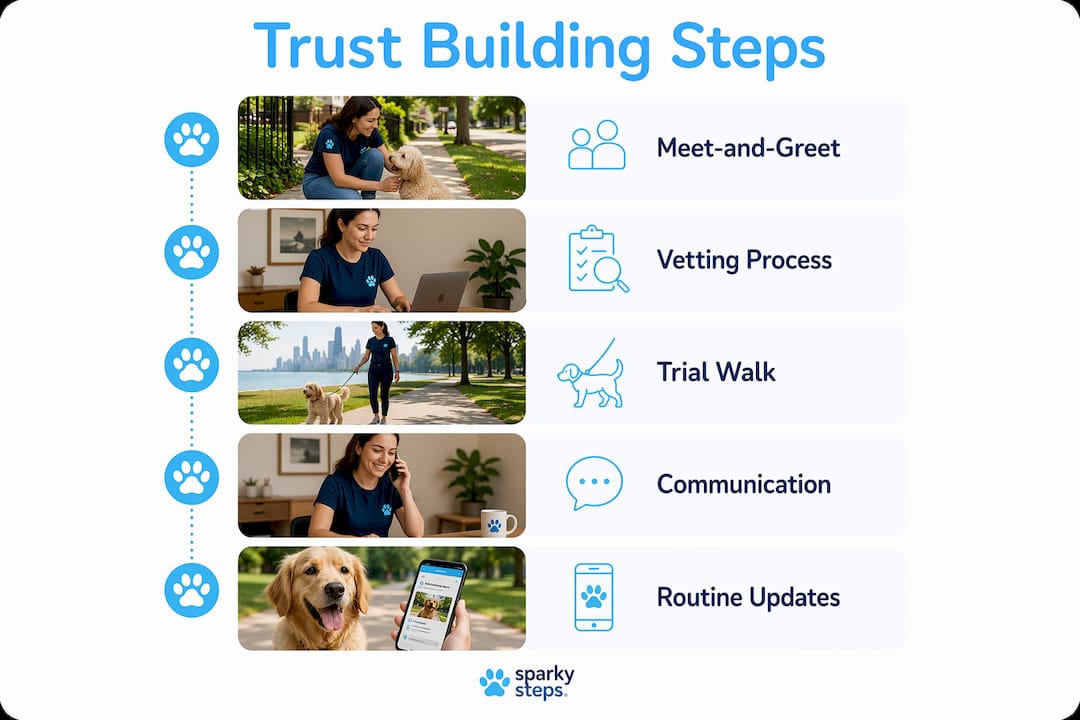
When you do the trial walk, go along and watch closely. Pay attention to how the walker manages the leash, reads your dog's signals, and responds when something unexpected happens on the sidewalk. How they handle your dog when the environment gets busy tells you almost everything you need to know.
Red flags to watch for: a walker who refuses to share insurance details, cannot name their emergency vet protocol, or dismisses your dog's behavioral quirks as "no big deal." Trust your gut. If something feels off in the vetting process, it will feel worse at 7 AM on a Tuesday when you are already late for work.
How do routines and communication habits deepen trust over time?
Consistent routines are the engine of a lasting walker relationship. Dogster and MSPCA both identify consistency and proactive communication as the primary factors that maintain trust with dog walkers over time. A walker who shows up at the same time, follows the same route, and sends updates after every visit gives your dog a predictable experience. Predictability reduces anxiety for dogs and for pet parents.
Create a weekly walk packet and update it whenever anything changes. MSPCA-Angell recommends including written details to reduce uncertainty for walkers. Your packet should cover:
- Preferred routes and routes to avoid (construction zones, aggressive dogs at specific addresses)
- Known triggers and how to handle them
- Current medications, dosage, and timing
- Feeding instructions if the walk overlaps with meal time
- What to do if your dog refuses to walk or shows signs of illness
Set clear expectations for updates from the start. Decide together whether you want a text after every visit, a photo, or a full report through a scheduling app. Sparky Steps uses DoTimely for GPS tracking, photos, and visit notes after every single visit. That level of real-time communication removes the guesswork entirely.
Here is a quick comparison of communication approaches and what each one delivers:
| Communication method | What it provides |
|---|---|
| Post-visit text message | Quick confirmation the walk happened |
| Photo update | Visual proof of your dog's condition and mood |
| GPS tracking via DoTimely | Route verification and real-time location |
| Written visit notes | Behavioral observations and any concerns flagged |
| Scheduled weekly check-in | Relationship building and proactive issue resolution |
Handle changes proactively. If your dog starts a new medication, tell the walker before the next visit, not after. If your schedule shifts, give as much notice as possible. Emergency readiness requires a clear process with named contacts, action thresholds, and incident documentation. Rehearse it once together so neither of you is figuring it out under pressure.
If you are also helping your dog adjust to other new routines at home, the tips on acclimating dogs to new situations from Lakewood Ranch Doodles offer useful context for building comfort with new caretakers.
What Chicago leash laws mean for your dog walker relationship
Chicago's leash and restraint laws directly affect the importance of dog walker trust. Under Chicago municipal code, dogs must be under control in public at all times. That means a leash of appropriate length and a handler who can physically restrain the dog if needed. A walker who does not know this is a liability risk for you, for them, and for your dog.
Ask every candidate these compliance questions before you hire:
- Do you know Chicago's leash length requirements?
- How do you handle a dog that pulls aggressively toward traffic?
- What do you do if a dog gets loose?
- Are you familiar with Chicago's dog bite liability laws?
This is not paranoia, it is basic due diligence. Chicago law places responsibility on the handler when a dog causes injury during a walk, and a walker counts as the dog's legal custodian while the animal is in their care. If your walker is not insured and bonded, you may share that liability. Confirming your walker's legal compliance protects everyone involved.
A walker who knows local law signals professionalism. It shows they have thought about their responsibility beyond just showing up with treats. For a deeper look at walking safely in Chicago's neighborhoods, the Chicago dog walking guide from Sparky Steps covers urban-specific safety practices in detail.
Leash etiquette also matters for your dog's behavior on walks. A dog that pulls and lunges creates more risk for the walker and for other pedestrians. Work on leash manners at home so your walker is not managing a safety crisis every time they clip the leash.
Key takeaways
| Point | Details |
|---|---|
| Start with a structured meet-and-greet | Share your dog's medical history, triggers, and home logistics before the first solo walk. |
| Vet beyond online reviews | Confirm insurance, bonding, background checks, and emergency procedures before hiring. |
| Use a weekly walk packet | Written routes, triggers, and medication details prevent miscommunication and build consistency. |
| Require real-time updates | GPS tracking, photos, and visit notes after every walk give you genuine peace of mind. |
| Know Chicago leash law | Your walker's legal compliance protects your dog, your walker, and your liability. |
What I have learned after years of watching trust get built (and broken)
By Michael Jaurigue, co-founder of Sparky Steps
I have been around Chicago dog walking long enough to know that trust does not come from a charming first impression. It comes from the third week, the fourth month, the moment something small goes wrong and the walker handles it calmly and tells you about it immediately.
The pet parents who struggle most with trusting a dog walker are the ones who skip the vetting process because the candidate seemed "really nice." Friendliness is not a safety protocol. A warm smile does not tell you what a walker does when your dog bolts toward a cyclist on the Lakefront Trail. That is why the trial walk, the insurance check, and the written walk packet matter so much. They are not bureaucratic hoops. They are the actual foundation of a professional relationship.
The other thing I have seen derail good walker relationships is inconsistent communication. Pet parents who never give feedback, walkers who never flag concerns, and both sides assuming everything is fine until it is not. The fix is simple: build a communication rhythm from day one and stick to it. A two-sentence text after every visit is not a burden. It is the glue.
One more thing: your dog knows. Dogs pick up on routine faster than most people realize. When the same trusted walkers show up at the same time, with the same energy, your dog relaxes into it. That relaxation is the clearest signal that the relationship is working. Honestly, if your dog is wagging before the walker even gets through the door, you have done everything right. 🐾
Michael Jaurigue
Sparky Steps makes it easy to find walkers you can actually trust
Sparky Steps has served 250+ Chicago pet parents since 2016, and every one of those relationships started with a proper meet-and-greet, a vetted care team, and a commitment to the same trusted walkers every time. No rotating strangers. No guessing who shows up at your door.
Every visit includes GPS tracking, photos, and visit notes through DoTimely, so you always know your dog is safe and well cared for. The care team is licensed, bonded, and insured, and every walker knows Chicago's leash laws and safety protocols. Whether you need professional dog running for a high-energy pup or trusted pet sitting when you travel, Sparky Steps builds the kind of consistent, reliable care routine that gives Chicago pet parents genuine peace of mind.
FAQ
What is the most important step to build trust with a dog walker?
The meet-and-greet is the most important first step. Sharing your dog's behavior, medical history, and home logistics upfront removes uncertainty and sets a professional tone from day one.
What questions should I ask a dog walker before hiring?
Ask about insurance and bonding, background checks, canine first aid training, emergency procedures, and incident reporting. IBPSA identifies these as the core trust indicators that go beyond what any review can tell you.
How do I know if a dog walker is reliable in Chicago?
Conduct a trial walk and observe leash control under mild distractions. A walker who stays calm and in control when your dog reacts to a distraction is demonstrating the day-to-day reliability you need on Chicago's busy streets.
Why does a weekly walk packet help with trusting a dog walker?
A written walk packet covering routes, triggers, and medication details prevents miscommunication and gives your walker everything they need to care for your dog consistently. It also creates a reference point if anything changes.
Are dog walkers liable under Chicago law if my dog bites someone?
Chicago law places responsibility on the handler when a dog causes injury during a walk, since a walker counts as the dog's legal custodian while it is in their care. Confirming your walker is insured and bonded protects both of you from shared liability in that situation.


