

Most dog walkers who struggle with growth aren't short on clients. They're short on systems. The difference between a burned-out solo walker and a thriving pet care professional almost always comes down to three things: how tightly you cluster your routes geographically, how much of your scheduling runs on automation, and how clearly you communicate with clients from day one. Get those right, and you can serve significantly more animals without working significantly more hours.
This guide is for working dog walkers and independent pet care professionals who are ready to grow past the "figure it out as I go" stage. It covers the practical systems, tools, and mindset shifts that actually make a difference.
The tools every professional walker needs
Without the right tools, you spend more time on administration than on actual walks. That's not a small problem. Every hour spent manually texting updates, chasing invoice payments, or rebuilding your calendar after a cancellation is an hour you're not earning.
Here's what a professional multi-client operation needs:
- Dedicated pet care scheduling software. A platform like DoTimely centralizes client profiles, recurring visit schedules, and GPS visit reporting in one place. Pet care apps that improve oversight do more than save admin time: they build the kind of client trust that reduces churn. Pet parents get visit updates without you typing a single text.
- Route planning tools. Apps that map your daily stops by geography cut down on wasted transit time between visits. Even a basic routing tool pays for itself in time saved within the first week.
- Client management and payment automation. Online booking, automated invoicing, and deposit collection at booking keep cash flow steady and reduce no-shows.
- A real client intake system. Every new client should complete a full profile before the first visit: pet medical history, feeding instructions, behavioral notes, emergency contacts, and vet information. This is not optional. It's the document that protects you and the animal if something goes wrong.
| Feature category | What it does | Why it matters |
|---|---|---|
| Scheduling and booking | Manages recurring visits, sends confirmations | Reduces no-shows and manual follow-up |
| Route planning | Maps stops by neighborhood cluster | Cuts unpaid transit time between clients |
| GPS visit reporting | Sends route, photos, and notes to pet parents | Builds trust without extra communication work |
| Payment and invoicing | Automates billing and deposit collection | Improves cash flow and reduces admin |
At Sparky Steps, we use DoTimely for exactly this reason. Every visit generates a real-time update with GPS tracking, photos, and notes sent directly to the pet parent. That level of transparency builds the kind of trust that keeps clients for years, not months.
Route optimization and geographic clustering
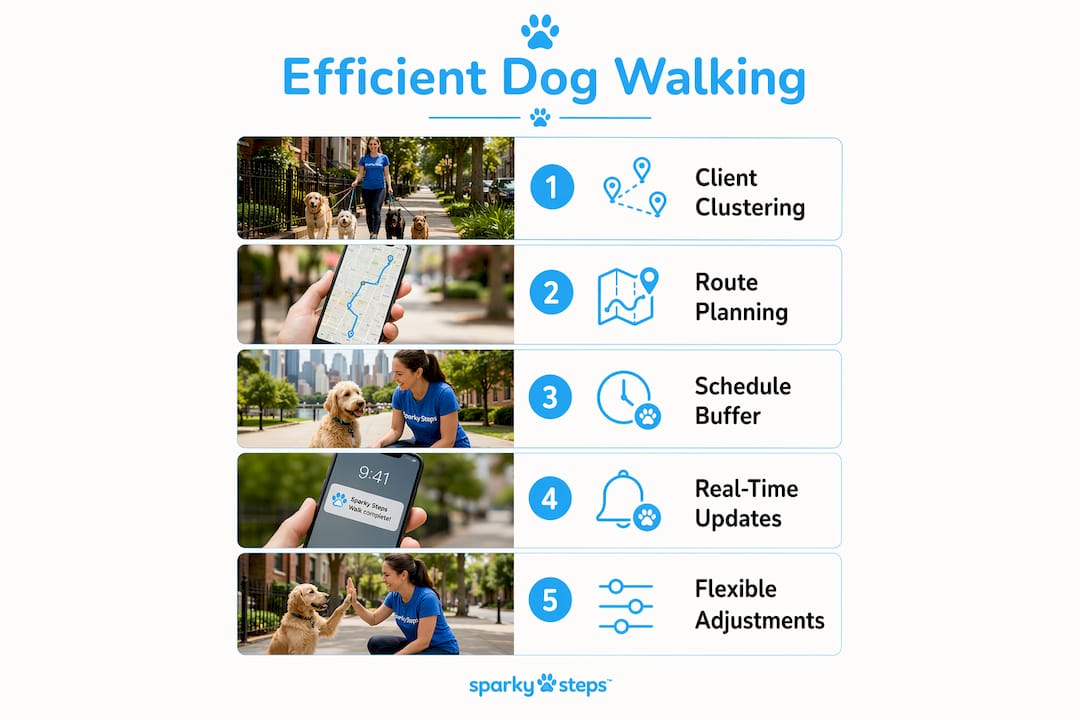
Route-density planning is the practice of grouping client visits by neighborhood so you spend more time walking and less time driving. Clustering clients into two or three service neighborhoods reduces daily unpaid transit by over 30 minutes compared to scattered bookings across a city. Over a five-day week, that's more than two hours of productive time recovered every week.
The practical approach works like this:
- Define two to three anchor neighborhoods where you accept the majority of new clients. For a Chicago North Side walker, that might be Ravenswood, Andersonville, and North Center. When a new inquiry comes in from outside those zones, you either apply a travel fee or refer them out. This feels uncomfortable at first. It is not leaving money on the table. It is protecting the quality you deliver to everyone else.
- Build time blocks by zone. Morning walks in one neighborhood, midday in another. Predictable daily geography creates predictable income and predictable service quality.
- Schedule 15-minute buffers between every walk. Not most walks. Every walk. Buffers absorb real-world delays: a dog who refuses to come inside, a parking situation, a client who wants to talk. Skip the buffers and one slow start cascades into a ruined afternoon. The buffers REALLY help out with work life balance too.
- Communicate your route constraints clearly. Tell new clients upfront which neighborhoods and time windows you serve. Most pet parents respect the structure when you explain it clearly. "I serve Ravenswood and Andersonville in morning time blocks" is a professional statement, not an apology. Clear communication will save you lots of headaches.
| Strategy | Benefit | How to implement it |
|---|---|---|
| Geographic clustering | Reduces daily transit time | Limit new clients to two to three core neighborhoods |
| Time-block scheduling | Creates predictable daily routines | Group morning and midday walks by zone |
| 15-minute buffers | Prevents cascading delays | Build into every transition, not just long ones |
| Flexible client windows | Fills schedule gaps efficiently | Offer a 30-minute arrival window instead of exact times |
Scheduling and communication systems that hold up under pressure
Most pet care professionals burn out from administrative overload, not from walking too many dogs. The fix is automation, not fewer clients. Automated reminders and deposit collection at booking decrease no-shows and improve cash flow without requiring you to chase anyone down.
Here's a numbered approach to building a schedule that holds up under pressure:
- Set anchor clients first. Fixed-time clients who need 7:00 AM or 12:00 PM walks go on the calendar before anything else. Build everything around them.
- Fill gaps with flexible clients. Clients with wider timing windows slot in around your anchors and keep your route tight. These clients are amazing, we love them.
- Add a buffer at every transition. A 15-minute gap between walks is your insurance policy against a dog who takes 10 extra minutes to settle. Sometimes things happen on those walks, its real.
- Automate confirmations and reminders. Set 24-hour automated reminders for every visit. Clients appreciate the heads-up, and you reduce last-minute surprises without spending any time on it.
- Batch your admin. Invoicing, responding to inquiries, and updating client notes all happen in one daily block, not scattered throughout the day. This single habit reclaims more time than most walkers expect.
One practical note on client communication: set a 2-hour arrival window rather than an exact time for non-anchor clients. It gives you scheduling flexibility and reduces anxiety on both ends when a walk runs long. Most pet parents adapt easily once you explain why. Although, honestly I'm thinking about extending it to a 3-hour arrival window.
Scaling beyond solo: what actually changes
Solo walkers face a real revenue ceiling, typically somewhere between $90,000 and $120,000 annually when working at full capacity. Team-based operations can reach $200,000 to $400,000 or more, but only by shifting from doing the work to managing the people who do it. That's a fundamentally different job, and the walkers who struggle with the transition are almost always the ones who didn't realize the job had changed.
Scaling beyond solo requires:
- Documented processes. Every workflow, from client onboarding to visit reporting, needs to be written down so any team member can follow it consistently. If it lives only in your head, you're not scalable. The more SOP's the better, for real.
- Hiring standards, not just availability. Background checks (we use CheckR), trial periods, and clear expectations before the first paid visit. The cost of a bad hire in this industry is a lost client and a damaged reputation, not just a scheduling headache. If you're thinking about hiring your first dog walker, start with your values, not just your schedule gaps.
- Delegation as a discipline. The hardest shift for solo walkers is stepping back from daily walks to focus on operations. Many resist it because they're great at the walk and new to managing people. The ones who embrace it grow. Those who do not hit a ceiling remain there.
- A backup network. One of the biggest structural problems for any small pet care operation is what happens when you get sick, need a day off, or want to take a vacation. Without backup coverage, taking time off means losing clients. Building backup relationships, whether through a partner network or trusted colleague arrangements, is the most underinvested piece of infrastructure in small pet care operations. Hit us up if you want to partner with us!
Common challenges and how to handle them before they become crises
Multi-client operations run into predictable problems. Knowing them in advance means you can build systems for them rather than improvising under pressure.
- Last-minute cancellations. A written cancellation policy with a 24-hour notice requirement and a fee for late cancellations protects your income without alienating good clients. Collect a deposit at booking and the problem mostly disappears.
- Out-of-zone inquiries. Apply a travel fee to clients outside your core service area, or refer them to someone who serves that neighborhood. Out-of-zone clients cost you time and money in ways that aren't always visible until they've eroded your margins for months.
- Double bookings. Scheduling software with real-time calendar sync eliminates this. A paper calendar or a mental one does not.
- Client timing expectations. Set a 2-hour+ arrival window upfront. Manage expectations before the first visit and you won't be managing complaints after it.
- Rushing visits under volume pressure. The fastest way to lose long-term clients is to cut visit lengths when your schedule gets tight. A rushed walk is a broken promise, and pet parents notice.
- No backup when you're unavailable. What happens to your clients when you get the flu? If the answer is "I figure it out," that's not a system. That's a crisis waiting to happen.
Key takeaways
- Route density is the highest-leverage change most solo walkers can make: clustering clients in two to three neighborhoods cuts daily transit by 30 minutes or more.
- Automation reduces burnout by removing admin from your day, not by reducing the number of clients you serve.
- Buffer time between walks is non-negotiable. Build it in before you need it.
- Scaling to a team requires documented processes, hiring standards, and the willingness to delegate the walks so you can manage the operation.
- Backup coverage is an operational necessity. If you can't take a sick day without losing clients, you don't have a business yet. You have a very demanding job.
What I've learned from building a team-based operation in Chicago
By Michael Jaurigue, co-founder of Sparky Steps
"The walkers who burn out are almost never the ones with too many dogs. They're the ones with too little structure. I've watched talented, genuinely caring walkers quit not because the work was hard but because the admin ate them alive. The conventional wisdom says "just get more clients." That advice is MEH.
More clients without better systems just means more chaos at a higher volume. The real move is to build the system first, then fill it with clients. Geographic clustering felt counterintuitive to me early on. Turning down a client because they live four neighborhoods away seemed like leaving money on the table. It's not, for real. It is protecting the service you deliver to everyone else.
Automation is not about being impersonal. DoTimely sends GPS updates and photos after every single visit, and pet parents tell us it makes them feel like they were there themselves. That is not cold technology. That is trust at scale. If you are building a dog walking business and you are still managing everything in your head or on a paper calendar, I say this with genuine warmth: you are one bad week away from a breakdown. Build the system. Your clients, your dogs, and your future self will thank you."
- Michael Jaurigue
Already running a solid operation? Let's talk.
If you've built a legitimate dog walking business in Chicago and you're looking for backup coverage, a professional peer network, and a client pipeline, Sparky Steps is worth a conversation.
Our partner network is built around a simple idea: independent walkers shouldn't have to choose between taking a day off and keeping their clients. Partners in our network keep 80% on every solo visit, operate as independent 1099 contractors, and plug into a backup system where a trusted colleague covers their visits when they need time away.
We're not looking for gig workers. We're looking for professionals who take this work seriously and want to do it sustainably for the long run.
Learn about working with Sparky Steps →
FAQ
How many dog walking clients can one person realistically handle per day?
Most solo walkers can handle six to eight visits per day while maintaining quality service. Geographic clustering and 15-minute buffers between walks are the primary factors that determine sustainable daily capacity. Above eight visits, service quality almost always starts to slip without a team in place.
What scheduling software works best for dog walkers?
DoTimely is a strong choice for pet care professionals because it combines client profiles, GPS tracking, recurring scheduling, and automated client updates in one platform. The right software depends on your team size and service area, but any dedicated pet care platform will outperform a general calendar app for this specific use case.
How do I reduce last-minute cancellations?
Collect a deposit at booking and have a written 24-hour cancellation policy that clients sign at onboarding. Automated 24-hour reminders also help. Clients who have a financial stake in the appointment cancel far less often than clients who don't.
When should a solo dog walker hire their first team member?
Hire when your schedule is consistently full and you're turning away clients in your core service area. The right window is when you're at about 80 to 90 percent capacity for several consecutive weeks. Scaling before that creates management overhead without the revenue to support it.
What's the most common reason dog walking businesses stop growing?
No backup coverage. A solo walker who can't take a sick day, a vacation, or even an occasional personal day without losing clients will eventually burn out or lose clients anyway when something happens. Building backup relationships is the single most underinvested piece of infrastructure in small pet care operations.


