

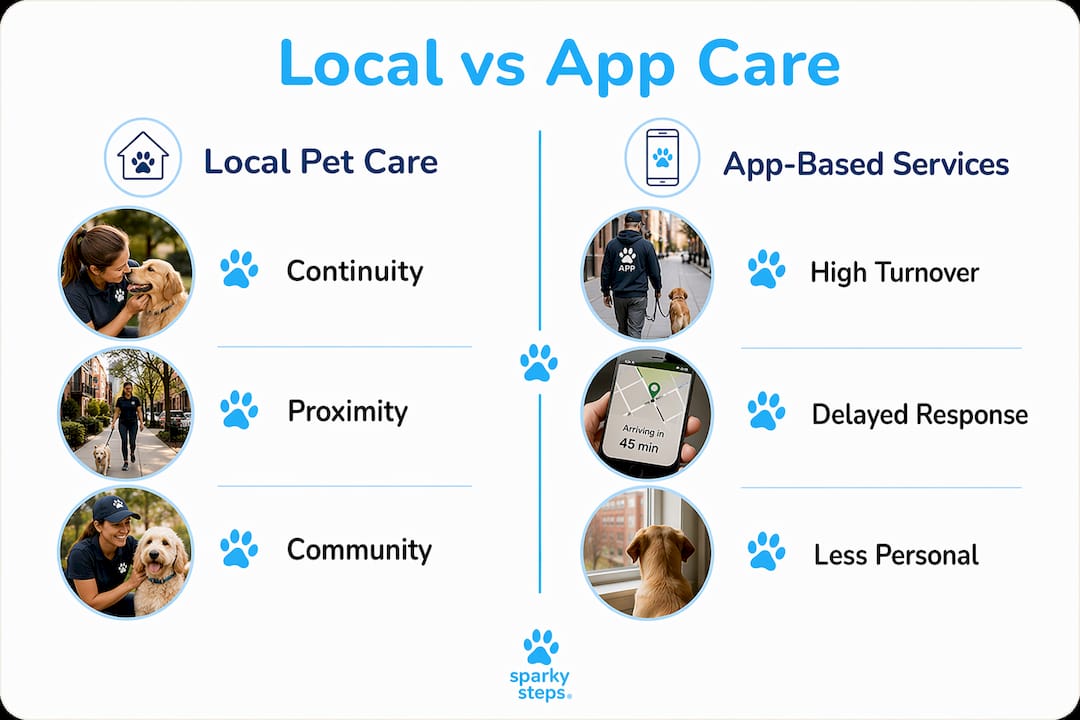
Local pet care is personalized, neighborhood-based service delivered by a consistent care team that knows your pet by name, routine, and quirk. With 71% of U.S. households owning pets as of early 2026, the demand for quality, accessible care has never been higher. That number represents 94 million households counting on someone to show up reliably. Why local pet care matters comes down to three things: continuity, proximity, and genuine community connection. None of those three things come standard with a stranger dispatched from an app.
Why local pet care matters for your pet's long-term health
Continuity of care is the single most underrated factor in pet health. Local providers build a longitudinal health baseline by seeing your pet consistently over months and years. That baseline is what makes early detection possible. A walker who has visited your dog every Tuesday for two years will notice when he is slower on the stairs. A rotating stranger will not.

App-based services lack longitudinal health awareness because high staff turnover means no single person ever builds that picture of your pet. Think of it like going to a new doctor every single visit. You would spend the whole appointment catching them up instead of actually getting care. Local care teams skip that step entirely because they already know your pet's story.
Trust also plays a direct role in health outcomes. Pets that recognize their walkers and vets show lower stress responses during visits and comply better with handling. Relational care models that emphasize trust and social context improve long-term pet health outcomes far beyond what transactional services can deliver. A calm pet is a pet that gets better care, full stop.
Here is what consistent local care actually looks like in practice:
- Early behavioral detection. The same walkers notice when your dog stops greeting them at the door, a sign that could indicate pain, anxiety, or illness.
- Medication and routine tracking. Local teams remember that your cat gets a pill at 3 PM and that your rabbit hates loud noises.
- Stress reduction. Familiar faces mean lower cortisol levels for your pet during every visit.
- Health history context. Local vets and walkers can connect current symptoms to past patterns without you having to explain everything from scratch.
Pro tip: Ask your local care provider to keep a simple visit log. Over time, that log becomes a behavioral health record that can help your vet spot trends faster.
How proximity makes local pet care better in emergencies
Speed matters when your dog swallows something he should not have, or your cat stops eating on a Friday afternoon. Local providers respond faster in emergencies because they are already embedded in your neighborhood. Local providers integrate with neighborhood ecosystems, forming proactive relationships with nearby specialists that allow faster emergency coordination. That network does not exist when your care provider is a stranger dispatched from across the city.
Proximity also shapes everyday behavior. When a vet or walker is five minutes away, you schedule that routine visit. When they are 40 minutes away, you put it off. Delayed routine care is one of the most common drivers of preventable health crises in pets. Convenience is not a luxury here. It is a clinical advantage.
Here is how accessible local care improves routine and emergency outcomes:
- Faster emergency response. A local provider with established specialist relationships can get your pet seen in hours, not days.
- Reduced travel stress. Shorter trips mean less anxiety for your pet before the visit even begins.
- Consistent scheduling. Community clinics often run structured hours, such as Tuesday through Saturday, 8 AM to 12 PM and 1 PM to 5 PM, making it easy to plan around your week.
- Preventive visit compliance. Pet parents who live near their care providers visit more often, catching problems before they become expensive.
- Home check-in capability. Local walkers can do a quick emergency pet sitting visit on short notice because they are already in the neighborhood.
What makes local pet care businesses better than app-based services
The difference between a local pet care business and an app-based service is not just personality. It is structure. Local pet care businesses invest in staff training, fair pay, and insurance, unlike disposable labor models common in app-based platforms. That investment shows up in the quality of every single visit. You cannot fake it when the same walkers show up week after week and your pet is thriving.
High ratings on app-based platforms often mask serious structural problems. Turnover is high, training is minimal, and no single person is accountable for your pet's wellbeing over time. Structural accountability in local pet care leads to higher staff retention and more consistent, reliable care. Retention is not just good for business. It is good for your dog.
Local businesses also create calmer, more tailored environments. Small care teams mean your pet is not shuffled through a rotating cast of strangers. Communication is direct and transparent. You know who to call, and that person knows your pet. The real benefits of local dog walkers go well beyond the walk itself. They include accountability, relationship, and the kind of neighborhood trust that no algorithm can replicate.
Pro tip: When evaluating any pet care provider, ask two questions: "Will my pet see the same person every visit?" and "Are your walkers licensed, bonded, and insured?" If the answer to either is unclear, keep looking.
There is also an economic dimension worth naming. Choosing a local pet care business keeps money in your neighborhood. Local businesses hire locally, refer locally, and build the kind of community fabric that makes a neighborhood feel like home. That is not a small thing, especially in a city like Chicago where neighborhoods have real identity and real relationships.
How local pet care connects to community health and well-being
Local pet care does not exist in a vacuum. It connects to a broader web of community health. Many pet parents prioritize pet care over their own services due to a lack of local support, which means gaps in local pet care create ripple effects on human health too. When pet parents cannot find affordable, accessible care for their animals, they delay their own medical visits, miss work, and carry chronic stress. Local care infrastructure solves more than one problem at a time.
The One Health framework, used by veterinary and public health professionals, recognizes that animal health, human health, and community health are deeply linked. Community veterinary clinics and neighborhood pet care providers are practical expressions of that framework. They address socioeconomic barriers, reduce emergency room visits for pets, and keep families intact during crises.
Local pet care also supports owners who might otherwise feel isolated. Knowing your dog walker by name, trusting that the same walkers will show up, and having a care team that checks in after every visit creates a social support structure that matters. For urban pet parents, especially those living alone, that connection is real and valuable.
Key takeaways
Local pet care delivers measurable benefits in health, safety, and community connection that app-based or distant services consistently fail to match.
| Point | Details |
|---|---|
| Continuity builds health baselines | The same care team detects subtle changes in your pet's behavior before they become serious problems. |
| Proximity improves emergency outcomes | Local providers with neighborhood specialist networks respond faster when your pet needs urgent help. |
| Structural accountability matters | Licensed, bonded, and insured local businesses invest in training and retention, producing more reliable care. |
| Community integration benefits everyone | Local pet care supports human health, reduces stress, and keeps neighborhood economies strong. |
| Relational care outperforms transactional care | Trust-based models improve pet compliance, reduce anxiety, and produce better long-term health outcomes. |
What ten years in Chicago taught me about local pet care
By Michael Jaurigue, co-founder of Sparky Steps
"I have been doing this since 2016, and the thing that still surprises people is how much the relationship itself is the service. Pet parents call us not just because their dog needs a walk, but because they need to know everything is okay. That peace of mind is not a bonus feature. It is the whole point, for real.
I have watched what happens when a pet parent switches from a rotating app-based service to a consistent local team. The pet relaxes within a few weeks. The pet parent stops anxiously checking their phone. And the walkers start noticing things, small things, that end up mattering a lot. One of our walkers noticed a senior dog favoring his left leg three weeks before his vet visit. That early heads-up led to a diagnosis that changed his treatment plan.
The importance of community pet care is not abstract to me. It is the neighbor who texts you when your cat seems off. It is the walker who knows your dog is scared of thunderstorms and plans accordingly. It is the care team that shows up on a holiday because they said they would. You cannot build that with an algorithm. You build it with time, consistency, and genuine care for the animals and the people who love them.
If you are an urban pet parent weighing your options, I would ask you to think less about price per visit and more about who is actually showing up. The cheapest option is rarely the one that calls you when something seems wrong."
- Michael Jaurigue
Sparky Steps brings local pet care to Chicago's North Side
Sparky Steps has served 250+ Chicago pet parents across neighborhoods like Ravenswood, Andersonville, Edgewater, and Albany Park for ten years. Every visit is handled by the same trusted walkers, licensed, bonded, and insured, who know your pet's personality and routine. Real-time updates via DoTimely mean GPS tracking, photos, and visit notes land in your pocket after every single visit.
Whether your dog needs professional dog running to burn off that big-city energy or your cat needs attentive pet sitting in Chicago while you travel, Sparky Steps delivers the kind of consistent, neighborhood-based care this article is all about.
FAQ
Why does local pet care matter more than app-based services?
Local pet care builds continuity, trust, and a longitudinal health baseline that rotating app-based walkers cannot provide. The same care team notices subtle behavioral and physical changes that prevent health crises before they start.
How does proximity help in a pet emergency?
Local providers maintain established relationships with nearby specialists, enabling faster emergency coordination than non-local services. Shorter travel distances also reduce pet stress before and during urgent visits.
What should I look for in a local pet care provider?
Look for a provider that is licensed, bonded, and insured, sends the same walkers every visit, and offers real-time updates after each visit. Consistency and accountability are the two non-negotiable standards.
How does local pet care support community health?
Research shows that many pet parents delay their own healthcare when local pet care is unavailable, creating a direct link between pet care access and human well-being. Community-based care models address both simultaneously.
How often should my pet see a local vet or care provider?
Most community veterinary clinics recommend routine checkups at least once or twice per year, with more frequent visits for senior pets or those with chronic conditions. Regular local walker visits between vet appointments add an extra layer of behavioral monitoring.


